MCQ
The feasible solution for a $LPP$ is shown in Figure Let $z=3 x-4 y$ be the objective function. Minimum of $Z$ occurs at $....$
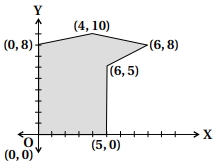
  • A
    $(0,0)$
  • $(0,8)$
  • C
    $(5,0)$
  • D
    $(4,10)$

Answer

Correct option: B.
$(0,8)$
b
$(B) \,\,(0,8)$

Corner point

Objective function

$z=3 x-4 y$

$(0,0)$ $z=3(0)-4(0)=0$
$(5,0)$ $z=3(5)-4(0)=15$ (Maximum value)
$(6,5)$ $z=3(6)-4(5)=18-20=-2$
$(6,8)$ $z=3(6)-4(8)=-14$
$(4,10)$ $z=3(4)-4(10)=-28$
$(0,8)$ $z=3(0)-4(8)=-32($ minimum value )

Minimum value of the objective function is $-32$

$\therefore$ Minimum value exists at point $(0,8).$


Need a full question paper?

Generate a complete, print-ready paper with questions like this in minutes — across 16+ boards, with answer keys.

Start Generating Free

Similar questions

A four-digit number is formed by using the digits 1, 2, 4, 8 and 9 without repitition. If one number is selected from those numbers, then what is the probability that it will be an odd number?
If the function $f(x) = x^5 + e^{\frac {x}{5}}$ and $g(x) = f^{-1} (x)$ , then the value of $\frac{1}{{g'\left( {1 + {e^{1/5}}} \right)}}$ is
If the system of equations

$2 x+y-z=5$

$2 x-5 y+\lambda z=\mu$

$x+2 y-5 z=7$

has infinitely many solutions, then $(\lambda+\mu)^2+(\lambda-\mu)^2$ is equal to
Let $f : R \rightarrow R$ be continuous function satisfying $f ( x )+ f ( x + k )= n$, for all $x \in R$ where $k >0$ and $n$is a positive integer. If $I _{1}=\int\limits_{0}^{4 n k} f ( x ) dx$ and $I _{2}=\int\limits_{- k }^{3 k } f ( x ) dx$, then
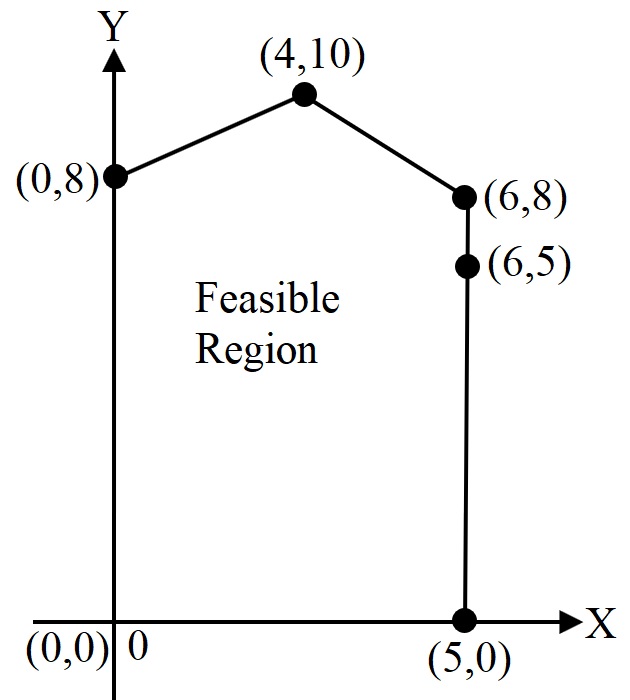
The feasible region for a LPP is shown shaded in the figure. Let Z = 3x - 4y be the objective function. Minimum of Z occurs at.

The determinant $\begin{vmatrix}\text{b}^2-\text{ab}&\text{b}-\text{c}&\text{bc}-\text{ac}\\\text{ab}-\text{a}^2&\text{a}-\text{b}&\text{b}^2-\text{ab}\\\text{bc}-\text{ac}&\text{c}-\text{a}&\text{ab}-\text{a}^2\end{vmatrix}$ equals:
  1. abc(b - c)(c - a)(a - b)
  2. (b - c)(c - a)(a - b)
  3. (a + b + c)(b - c)(c - a)(a - b)
  4. None of these
$\int_{}^{} {\sin 2x\cos 3x\;dx = } $
Let $A=\left[\begin{array}{cc}0 & -2 \\ 2 & 0\end{array}\right]$. If $M$ and $N$ are two matrices given by $M =\sum \limits_{ k =1}^{10} A ^{2 k }$ and $N =\sum \limits_{ k =1}^{10} A ^{2 k -1}$ then $MN ^{2}$ is
If f:R→R, f(x)=2x+1 , then the value of f-1 (2) is
If ${a^2}{x^4} + {b^2}{y^4} = {c^6},$ then maximum value of $xy $ is