MCQ
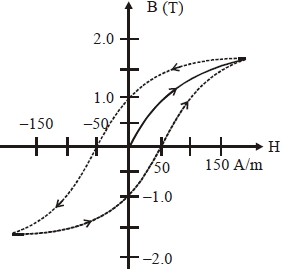
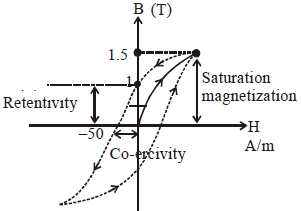
The figure gives experimentally measured $\mathrm{B}$ vs. $H$ variation in a ferromagnetic material. The retentivity, co-ercivity and saturation. respectively, of the material are
  • A
    $150 \;\mathrm{A} / \mathrm{m}, 1.0\; \mathrm{T}$ and $1.5\; \mathrm{T}$
  • $1.0 \;\mathrm{T}, 50\; \mathrm{A} / \mathrm{m}$ and $1.5\; \mathrm{T}$
  • C
    $1.5\; \mathrm{T}, 50\; \mathrm{A} / \mathrm{m}$ and $1.0 \;\mathrm{T}$
  • D
    $1.5\; \mathrm{T}, 50 \;\mathrm{A} / \mathrm{m}$ and $1.0 \;\mathrm{T}$
Answer

Correct option: B.
$1.0 \;\mathrm{T}, 50\; \mathrm{A} / \mathrm{m}$ and $1.5\; \mathrm{T}$
b
Retentivity $=1.0 \mathrm{T}$

Co-ercivity $=50 \mathrm{A} / \mathrm{m}$

Saturation $=1.5 \mathrm{T}$

Need a full question paper?

Generate a complete, print-ready paper with questions like this in minutes — across 16+ boards, with answer keys.

Start Generating Free

Similar questions

An iron rod of volume ${10^{ - 4}}\,{m^3}$ and relative permeability $ 1000$  is placed inside a long solenoid wound with $5 $ $turns/cm$. If a current of $0.5 \,A $ is passed through the solenoid, then the magnetic moment of the rod is....$A{m^2}$
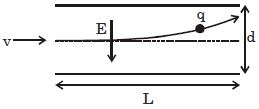
In an ink-jet printer, an ink droplet of mass $m$ is given a negative charge $q$ by a computer-controlled charging unit, and then enters at speed $v$ in the region between two deflecting parallel plates of length $L$ separated by distance $d$ (see figure below). All over this region exists a downward electric field which you can assume to be uniform. Neglecting the gravitational force on the droplet, the maximum charge that can be given so that it will not hit a plate is close to :
In series $RLC$ circuit $(AC)$

$L = 10\, mH$

$C = 0.01\,\mu F$

$R = 50\,\Omega $

If supply voltage is $V = 10\sin \omega t$ then find power dissipated at resonance......$W$

Two vibrating tuning forks produce progressive waves given by ${Y_1} = 4\sin 500\pi t$ and ${Y_2} = 2\sin 506\pi t.$ Number of beats produced per minute is
A frictionless pulley is attached to one arm of a balance and a string passed around it carries two masses $m_1$ and $m_2$. The pulley is provided with $a$ clamp due to which $m_1$ and $m_2$ do not move $w.r.t.$ each other. On removing the clamp, if the counter mass restores balance, then acceleration of centre of mass of the masses $m_1$ and $m_2$ will have acceleration of magnitude ? 
The gravitational potential at a point above the surface of earth is $-5.12 \times 10^7 \mathrm{~J} / \mathrm{kg}$ and the acceleration due to gravity at that point is $6.4 \mathrm{~m} / \mathrm{s}^2$. Assume that the mean radius of earth to be $6400 \mathrm{~km}$. The height of this point above the earth's surface is :
A particle is placed at the origin and a force $F = kx$is acting on it (where $k$ is positive constant). If $U(0) = 0$, the graph of $U(x)$ versus x will be (where $U$ is the potential energy function)
An electron collides with a free molecule initially in its ground state. The collision leaves the molecule in an excited state that is metastable and does not decay to the ground state by radiation. Let $K$ be the sum of the initial kinetic energies of the electron and the molecule and $p$ be the sum of their initial momenta. Let $K^{\prime}$ and $p ^{\prime}$ represent the same physical quantities after the collision. Then,
$Assertion$ : There are very small sporadic changes in the speed of rotation of the earth
$Reason$ : Shifting of large air masses in the earth's atmosphere produce a change in the moment of inertia of the earth causing its speed of rotation to change.
${T}_{0}$ is the time period of a simple pendulum at a place. If the length of the pendulum is reduced to $\frac{1}{16}$ times of its initial value, the modified time