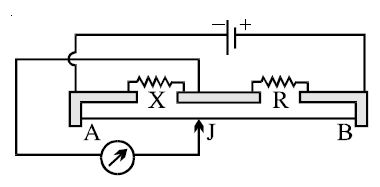
The figure shows a meter-bridge circuit, with $AB = 100\, cm$,$ X = 12\,\Omega$ and $R = 18\,\Omega$ , and the jockey $J$ in the position of balance. If $R$ is now made $8\,\Omega$ , through what distance will $J$ have to be moved to obtain balance? .............. $cm$
Diffcult
Download our app for free and get started
The balancing condition for meter bridge is,
$\frac{X}{R}=\frac{l_{1}}{100-l_{1}}$
$X=R\left(\frac{l_{1}}{100-l_{1}}\right)$
$12=18\left(\frac{l_{1}}{100-l_{1}}\right)$
$1200=30 l_{1}$
$l_{1}=40 \mathrm{cm}$
When $R=8$ ohm,
$12=8\left(\frac{l_{2}}{100-l_{2}}\right)$
$1200=20 l_{2}$
$l_{2}=60 \mathrm{cm}$
Hence, distance through $J$ is shifted is
$l=l_{2}-l_{1}=20 \mathrm{cm}$

Download our appand get started for free
Experience the future of education. Simply download our apps or reach out to us for more information. Let's shape the future of learning together!No signup needed.*
Similar Questions
- 1The current through a wire depends on time as $i = (2+3t)\, mA$. The charge crossing through a section of the wire in $1\, min$ is .............. $\mathrm{C}$View Solution
- 2View SolutionGiven three equal resistors, how many different combination of all the three resistors can be made
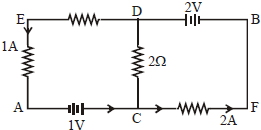
- 3In the circuit, given in the figure currents in different branches and value of one resistor are shown. Then potential at point $B$ with respect to the point $A$ is$.......V$View Solution
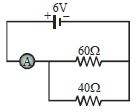
- 4The measurement of ammeter in the following circuit is ................... $A$ (Assuming ideal ammeter)View Solution
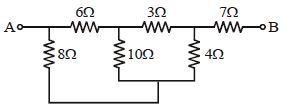
- 5The equivalent resistance between the points $A$ and $B$ is :-View Solution
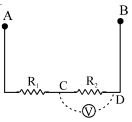
- 6Resistances $R_1$ and $R_2$ each $60\,\Omega$ are connected in series as shown in figure. The Potential difference between $A$ and $B$ is kept $120$ volt. Then what ............. $V$ will be the reading of voltmeter connected between the point $C$ and $D$ if resistance of voltmeter is $120\,\Omega .$View Solution
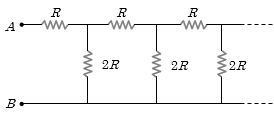
- 7An infinite ladder network is arranged with resistances $R$ and $2 R$ as shown. The effective resistance between terminals $A$ and $B$ isView Solution
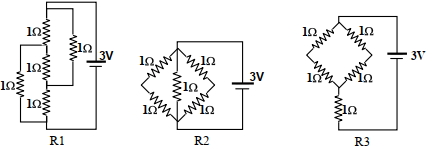
- 8Figure shows three resistor configurations $\mathrm{R} 1, \mathrm{R} 2$ and $\mathrm{R} 3$ connected to $3 \mathrm{~V}$ battery. If the power dissipated by the configuration $\mathrm{R} 1, \mathrm{R} 2$ and $\mathrm{R} 3$ is $\mathrm{P} 1, \mathrm{P} 2$ and $\mathrm{P} 3$, respectively, thenView Solution
Figure:
- 9Column $- I$ gives certain physical terms associated with flow of current through a metallic conductor. Column $- II$ gives some mathematical relations involving electrical quantities. Match Column $- I$ and Column $- II$ with appropriate relations.View Solution
Column $- I$ Column $- II$ $(A)$ Drift Velocity $(P)$ $\frac{m}{n e^{2} \rho}$ $(B)$ Electrical Resistivity $(Q)$ $\mathrm{ne} v_{\mathrm{d}}$ $(C)$ Relaxation Period $(R)$ $\frac{\mathrm{eE}}{\mathrm{m}} \tau$ $(D)$ Current Density $(S)$ $\frac{E}{J}$ - 10In the network shown the potential difference between $A$ and $B$ is ................. $V$ $(R = r_1 = r_2 = r_3 = 1 \Omega$ ,$ E_1 = 3\, V, E_2 = 2\, V, E_3 = 1\, V)$View Solution