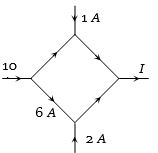
The figure shows a network of currents. The magnitude of currents is shown here. The current $I$ will be ........... $A$
Easy
Download our app for free and get started
(c) On applying Kirchoff's current law $i = 13\, A.$

Download our appand get started for free
Experience the future of education. Simply download our apps or reach out to us for more information. Let's shape the future of learning together!No signup needed.*
Similar Questions
- 1In a hydrogen discharge tube it is observed that through a given cross-section $3.13 \times {10^{15}}$ electrons are moving from right to left and $3.12 \times {10^{15}}$ protons are moving from left to right. What is the electric current in the discharge tube and what is its directionView Solution
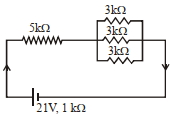
- 2In the figure given, the electric current flowing through the $5\, k \Omega$ resistor is $'x' mA.$View Solution
The value of $x$ to the nearest integer is .........
- 3View SolutionIn the circuit shown in the figure, the current through
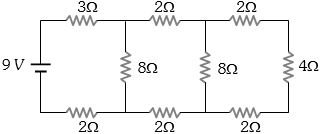
- 4$10$ resistors each of resistance $10\,\Omega$ can be connected in such as to get maximum and minimum equivalent resistance. The ratio of maximum and minimum equivalent resistance will be $..........$.View Solution
- 5A wire of resistance $20 \Omega$ is divided into $10$ equal parts. A combination of two parts are connected in parallel and so on. Now resulting pairs of parallel combination are connected in series. The equivalent resistance of final combination is_______.0$\Omega$.View Solution
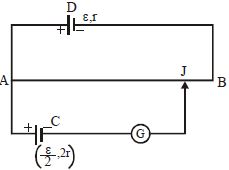
- 6In the figure, the potentiometer wire $AB$ of length $L$ and resistance $9r$ is joined to the cell $D$ of $emf$ $\varepsilon $ and internal resistance $r$. The cell $C's$ $emf$ is $\frac{\varepsilon }{2}$and its internal resistance is $2r$. The galvanometer $G$ will show no deflection when the length $AJ$ isView Solution
- 7The charge flowing through a resistance $R$ varies with time according to $Q = at -bt^2.$ The total heat produced in $R$ is : (assume that direction of current not reversed)View Solution
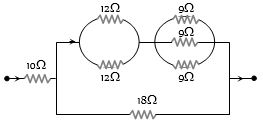
- 8In the following circuit, $18\,\Omega $ resistor develops $2\,J/sec$ due to current flowing through it. The power developed across $10\,\Omega $ resistance is .............. $W$View Solution
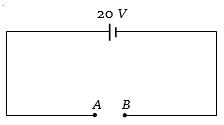
- 9In the shown circuit, what is the potential difference across $A$ and $B$ ......... $V$View Solution
- 10A $10\, V$ storage battery of negligible internal resistance is connected across a $50\,\Omega $ resistor. How much heat energy is produced in the resistor in $1$ hour ............... $J$View Solution