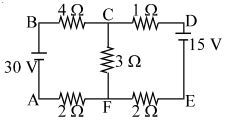
The figure shows a network of five resistances and two batteries The current through the $15\,V$ battery is .............. $A$
Diffcult


Download our appand get started for free
Experience the future of education. Simply download our apps or reach out to us for more information. Let's shape the future of learning together!No signup needed.*
Similar Questions
- 1$50\,\Omega $ and $100\,\Omega $ resistors are connected in series. This connection is connected with a battery of $2.4\, volts$. When a voltmeter of $100\,\Omega $ resistance is connected across $100\,\Omega $ resistor, then the reading of the voltmeter will be ............. $V$View Solution
- 2The resistivity of alloys $ = {R_{{\rm{alloy}}}}$; the resistivity of constituent metals ${R_{{\rm{metal}}}}$. Then, usuallyView Solution
- 3A cell of emf $6\, V$ and resistance $0.5\, ohm$ is short circuited. The current in the cell is ............... $amp$View Solution
- 4When a potential difference $V$ is applied across a wire of resistance $R$, it dissipates energy at a rate $W$. If the wire is cut into two halves and these halves are connected mutually parallel across the same supply, the same supply, the energy dissipation rate will become:View Solution
- 5An electric bulb is rated $60\,W$, $220\,V$. The resistance of its filament is ............. $\Omega$View Solution
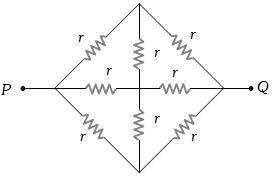
- 6The equivalent resistance between the points $P$ and $Q$ in the network given here is equal to ................ $\Omega$ (given $r = \frac{3}{2}\Omega $)View Solution
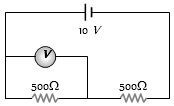
- 7A voltmeter of resistance $1000\,\Omega$ is connected across a resistance of $500\, \Omega$ in the given circuit. What will be the reading of voltmeter .............. $V$View Solution
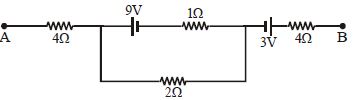
- 8In the circuit shown in figure, potential difference between points $A$ and $B$ is $16\, V$. The current passing through $2\,\Omega $ resistance will be ................. $\mathrm{A}$View Solution
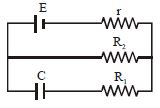
- 9In the given figure each plate of capacitance $C$ has partial value of chargeView Solution
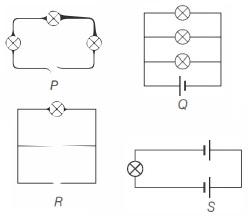
- 10Following figures show different combinations of identical bulb$(s)$ connected to identical battery$(ies)$. Which option is correct regarding the total power dissipated in the circuit?View Solution