MCQ
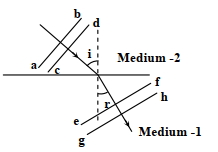
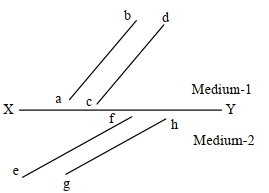
The figure shows a surface $XY$ separating two transparent media, medium -$1$ and medium -$2$. The lines $a b$ and cd represent wavefronts of a light wave travelling in medium-$1$ and incident on $XY$. The lines ef and gh represent wavefronts of the light wave in medium-$2$ after refraction.

$Image$

$1.$  Light travels as a

$(A)$ parallel beam in each medium

$(B)$ convergent beam in each medium

$(C)$ divergent beam in each medium

$(D)$ divergent beam in one medium and convergent beam in the other medium.

$2.$  The phases of the light wave at $\mathrm{c}, \mathrm{d}, \mathrm{e}$ and $\mathrm{f}$ are $\phi_{\mathrm{c}}, \phi_{\mathrm{d}}, \phi_{\mathrm{e}}$ and $\phi_{\mathrm{f}}$ respectively. It is given that $\phi_{\mathrm{c}} \neq \phi_{\mathrm{f}}$

$(A)$ $\phi_{\mathrm{c}}$ cannot be equal to $\phi_{\mathrm{d}}$

$(B)$ $\phi_{\mathrm{a}}$ can be equal to $\phi_{\mathrm{e}}$

$(C)$ $\left(\phi_{\mathrm{d}}-\phi_t\right)$ is equal to $\left(\phi_{\mathrm{c}}-\phi_{\mathrm{e}}\right)$

$(D)$ $\left(\phi_{\mathrm{d}}-\phi_c\right)$ is not equal to $\left(\phi_{\mathrm{f}}-\phi_e\right)$

$3.$  Speed of the light is

$(A)$ the same in medium-$1$ and medium-$2$

$(B)$ larger in medium-$1$ than in medium-$2$

$(C)$ larger in medium-$2$ than in medium-$1$

$(D)$ different at $\mathrm{b}$ and $\mathrm{d}$

Give the answer question $1, 2$ and $3.$
  • $A,C,B$
  • B
    $B,D,A$
  • C
    $C,D,A$
  • D
    $D,A,B$

Answer

Correct option: A.
$A,C,B$
a

Need a full question paper?

Generate a complete, print-ready paper with questions like this in minutes — across 16+ boards, with answer keys.

Start Generating Free

Similar questions

When an object is placed between two parallel mirrors, then number of images formed is
A nucleus of lead $Pb _{82}^{214}$ emits two electrons followed by an $\alpha$-particle. The resulting nucleus will have
An achromatic telescope objective is to be made by combining the lenses of flint and crown glasses. This proper choice is
An athlete completes one round of a circular track of radius $10\, m$ in $40\, sec$. The distance covered by him in $2 \,min$ $20 \,sec$ is ........ $m$
A body is thrown vertically upwards and takes $5$ seconds to reach maximum height. The distance travelled by the body will be same in
A ball is projected from the ground at an angle of $45^{\circ}$ with the horizontal surface. It reaches a maximum height of $120 m$ and returns to the ground. Upon hitting the ground for the first time, it loses half of its kinetic energy. Immediately after the bounce, the velocity of the ball makes an angle of $30^{\circ}$ with the horizontal surface. The maximum height it reaches after the bounce, in metres, is. . . . .
A beam of light consisting of two wavelengths $7000\; \mathring A$ and $5500 \;\mathring A$ is used to obtain interference pattern in Young's double slit experiment. The distance between the slits is $2.5\,mm$ and the distance between the plane of slits and the screen is $150\,cm$. The least distance from the central fringe, where the bright fringes due to both the wavelengths coincide, is $n \times 10^{-5}\,m$. The value of $n$ is .............
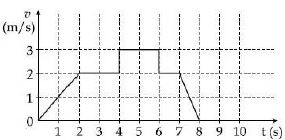
A particle starts from the origin at time $t = 0$ and moves along the positive $x-$ axis. The graph of velocity with respect to time is shown in figure. What is the position of the particle at time $t = 5\,s$ ?.........$m$
Which of the following circuits correctly represents the following truth table ?

$\begin{array}{*{20}{c}}A&B&C\\0&0&0\\0&1&0\\1&0&1\\1&1&0\end{array}$

A particle of mass $m$ moves in a circular orbit in a central potential field $U\left( r \right) = \frac{1}{2}k{r^2}$. If Bohr’s quantization conditions are applied, radii of possible orbits and energy levels vary with quantum number $n$ as