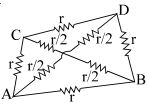
The figure shows a tetrahedron, each side of which has a resistance $r$ If a battery is connected between any two points of the tetrahedron, then identify the correct statement $(s)$.
Medium


Download our appand get started for free
Experience the future of education. Simply download our apps or reach out to us for more information. Let's shape the future of learning together!No signup needed.*
Similar Questions
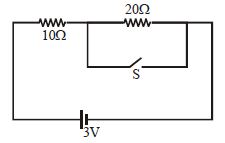
- 1Consider the circuit shown in fig. The current through the $10\,\Omega $ resistor when switch $'s'$ is $(a)$ open $(b)$ closed.View Solution
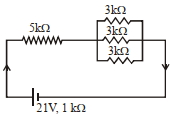
- 2In the figure given, the electric current flowing through the $5\, k \Omega$ resistor is $'x' mA.$View Solution
The value of $x$ to the nearest integer is .........
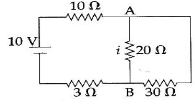
- 3In the electrical circuit shown in the figure, the current $i$ through the side $AB$ isView Solution
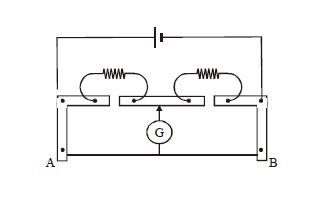
- 4A meter bridge set up as shown to determine end correction at $A$ and $B$. When a resistance of $15\ \Omega$ is used in left gap and of $20\ \Omega$ in right gap, then null point comes at a distance $42\ cm$ from $A$. When these resistances are interchanged null point comes at a distance $57\ cm$ from $A$. Values of end corrections areView Solution
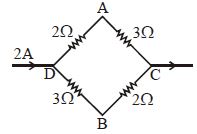
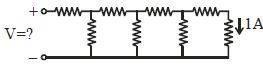
- 5Each element in the finite chain of resistors shown in the figure is $1\,\Omega $. A current of $1\, A$ flows through the final element. Then what is the potential difference $V$ across input terminals of the chain ............... $\mathrm{volt}$View Solution
- 6In a large building, there are $15$ bulbs of $40\ W$, $5$ bulbs of $100\ W, 5$ fans of $80\ W$ and $1$ heater of $1\ kW$. The voltage of electric mains is $220\ V$. The minimum capacity of the main fuse of the building will be ................ $A$View Solution
- 7Five cells each of emf $E$ and internal resistance $r$ are connected in series. Due to oversight one cell is connected wrongly. The equivalent internal resistance of the combination is ........... $r$View Solution
- 8There is a current of $1.344\, amp$ in a copper wire whose area of cross-section normal to the length of the wire is $1\,m{m^2}$. If the number of free electrons per $c{m^3}$ is $8.4 \times {10^{22}}$, then the drift velocity would beView Solution
- 9When two resistance $R_1$ and $R_2$ connected in series and introduced into the left gap of a meter bridge and a resistance of $10 \Omega$ is introduced into the right gap, a null point is found at $60 cm$ from left side. When $R_1$ and $R_2$ are connected in parallel and introduced into the left gap, a resistance of $3 \Omega$ is introduced into the right-gap to get null point at 40 cm from left end. The product of $R_1 R_2$ is $.............\Omega$View Solution
- 10A current of $2\, A$ flows in a system of conductors as shown. The potential difference $(V_A -V_B)$ will be ................ $\mathrm{V}$View Solution