MCQ
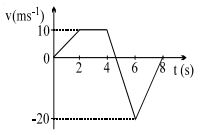
The figure shows a velocity-time graph of a particle moving along a straight line  If the particle starts from the position $x_0=-15\,m$ , then its position at $t=2\,s$ will be   ........ $m$
  • $-5$
  • B
    $5 $
  • C
    $10$
  • D
    $15 $

Answer

Correct option: A.
$-5$
a
displacement $=$ Area convered by $v-t$ graph on time axis

$x-x_{0}=\frac{1}{2} \times 2 \times 10$

$x-(-15)=10 \Rightarrow x=-5 m$

Need a full question paper?

Generate a complete, print-ready paper with questions like this in minutes — across 16+ boards, with answer keys.

Start Generating Free

Similar questions

A particle reaches its highest point when it has covered exactly one half of its horizontal range. The corresponding point on the displacement time graph is characterised by
A circular plate of uniform thickness of diameter $56\, cm$, whose center is at origin. A circular part of diameter $42\, cm$ is removed from one edge. What is the distance of the centre of mass of the remaining part ........ $cm.$
If, in Exercise $5.21,$ the speed of the stone is increased beyond the maximum permissible value, and the string breaks suddenly, which of the following correctly describes the trajectory of the stone after the string breaks:
Which of the following is not represented in correct unit
A long, straight wire carries a current along the $z-$axis, One can find two points in the $x−$yplane such that:
The range of a particle when launched at an angle of ${15^o}$ with the horizontal is $1.5 \,km$. What is the range of the projectile when launched at an angle of ${45^o}$ to the horizontal ........ $km$
A stone is shot straight upward with a speed of $20\, m/sec$ from a tower $200\, m$ high. The speed with which it strikes the ground is approximately........$m/sec$
If the radius of earth's orbit is made $1\frac{1}{4}$, the duration of an year will become
The angular amplitude of a simple pendulum is $\theta_0$. The maximum tension in its string will be
The resultant of $\overrightarrow A + \overrightarrow B $ is ${\overrightarrow R _1}.$ On reversing the vector $\overrightarrow {B,} $ the resultant becomes ${\overrightarrow R _2}.$ What is the value of $R_1^2 + R_2^2$