MCQ
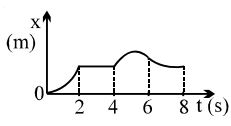
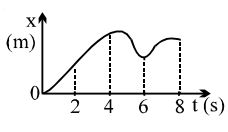
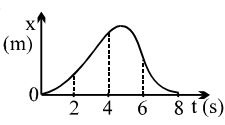
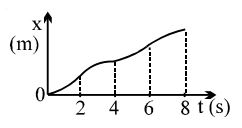
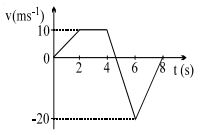
The figure shows a velocity-time graph of a particle moving along a straight line  The correct displacement-time graph of the particle is shown as
  • A

  • B


  • D

Answer

Correct option: C.

c

Need a full question paper?

Generate a complete, print-ready paper with questions like this in minutes — across 16+ boards, with answer keys.
Start Generating Free

Similar questions

The changes in displacement in three consecutive instances are $5m, 4m, 11m,$ the total time taken is $5s.$ What is the average velocity in $m/ s?$
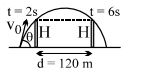
A projectile crosses two walls of equal height $H$ symmetrically as shown The maximum height of the projectile is  ........ $m$
A string of length $0.1\,m$ cannot bear a tension more than $100\,N$. It is tied to a body of mass $100\,g$ and rotated in a horizontal circle. The maximum angular velocity can be .......... $rad/sec$
According to the kinetic theory of gases, the temperature of a gas is a measure of average:
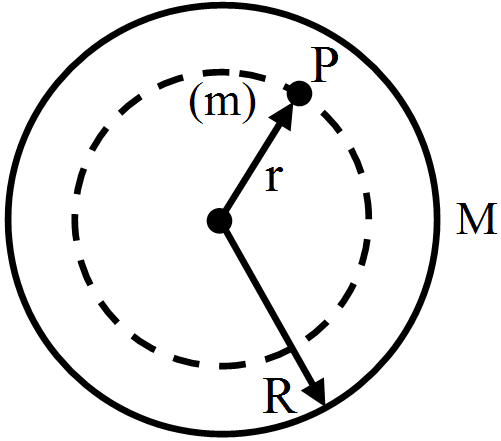
The force of attraction due to a hollow spherical shell of mass $M,$ radius $R$ and uniform density, on a point mass $m$ situated inside it is:
$Assertion :$ The amplitude of an oscillating pendulum decreases gradually with time
$Reason :$ The frequency of the pendulum decreases with time.
A particle released from rest is falling through a thick fluid under gravity. The fluid exerts a resistive force on the particle proportional to the square of its speed. Which one of the following graphs best depicts the variation of its speed $v$ with time $t$ ?
An earth satellite of mass $m$ revolves in a circular orbit at a height $h$ from the surface of the earth. $R$ is the radius of the earth and $g$ is acceleration due to gravity at the surface of the earth. The velocity of the satellite in the orbit is given by
When the temperature of a gas is $20^{\circ} C$ and pressure is changed from $P_1=1.01 \times 10^5 \,Pa$ to $P_2=1.165 \times$ $10^5 \,Pa$, then the volume changes by $10 \%$. The Bulk modulus is .........$\times 10^5 \,Pa$
Two bodies $A$ and $B$ collide as shown in Fig. $(i)$ and $(ii)$ Which statement is true ?