MCQ
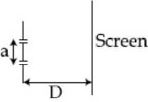
The figure shows a Young’s double slit experimental setup. It is observed that when a thin transparent sheet of thickness $t$ and refractive index $\mu $ is put in front of one of the slits, the central maximum gets shifted by a distance equal to $n$ fringe widths. If the wavelength of light used is $\lambda ,\,t$ will be
  • A
    $\frac{{2nD\lambda }}{{a\left( {\mu  - 1} \right)}}$
  • B
    $\frac{{nD\lambda }}{{a\left( {\mu  - 1} \right)}}$
  • C
    $\frac{{2D\lambda }}{{a\left( {\mu  - 1} \right)}}$
  • $\frac{{n\lambda }}{{\left( {\mu  - 1} \right)}}$
Answer

Correct option: D.
$\frac{{n\lambda }}{{\left( {\mu  - 1} \right)}}$
d
Path difference at central maxima $\Delta x=(\mu-1)\, t,$ whole pattern will shift by same amount which will be given by

$(\mu-1) \,t \frac{D}{d}=n \frac{\lambda D}{d},$ according to eh question $t=\frac{n \lambda}{(\mu-1)}$

No option is matching, therefore question should be award bonus.

$\therefore $ Correct option should be (Bonus)

Need a full question paper?

Generate a complete, print-ready paper with questions like this in minutes — across 16+ boards, with answer keys.

Start Generating Free

Similar questions

A $10\,\mu F$ capacitor is charged to a potential difference of $1000\, V$. The terminals of the charged capacitor are disconnected from the power supply and connected to the terminals of an uncharged $6\, \mu F$ capacitor. What is the final potential difference across each capacitor?......$V$
Two identical magnetic dipoles of magnetic moments $1.0 \,A-m^2$ each, placed at a separation of $2\,m$  with their axis perpendicular to each other. The resultant magnetic field at a point midway between the dipoles is
Four monochromatic and coherent sources of light, emitting waves in phase of wavelength $\lambda$ , are placed at the points $\rightarrow x = 0, d, 2d$ and $3d$ on the $x$ -axis. Then
The equation of motion of a projectile is:   $y = 12x - \frac{5}{9}{x^2}$. The horizontal component of velocity is $3\ ms^{- 1}$ . Given that $g = 10\ ms^{- 2}$ , .......... $m$ is the range of the projectile .
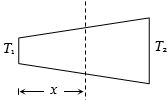
Radius of a conductor increases uniformly from left end to right end as shown in fig.Material of the conductor is isotropic and its curved surface is thermally isolated from surrounding. Its ends are maintained at temperatures $T_1$ and $T_2$ ($T_1$ > $T_2$): If, in steady state, heat flow rate is equal to $H$ , then which of the following graphs is correct
A capacitor of capacitance $15 \,nF$ having dielectric slab of $\varepsilon_{r}=2.5$ dielectric strength $30 \,MV / m$ and potential difference $=30\; volt$ then the area of plate is ....... $ \times 10^{-4}\; m ^{2}$
The energy stored in a condenser is in the form of
A block of mass $50\, kg$ slides over a horizontal distance of $1\, m$. If the coefficient of friction between their surfaces is $0.2$, then work done against friction is ......... $J$
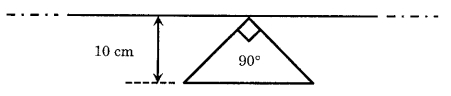
A conducting loop in the shape of a right angled isosceles triangle of height $10 \mathrm{~cm}$ is kept such that the $90^{\circ}$ vertex is very close to an infinitely long conducting wire (see the figure). The wire is electrically insulated from the loop. The hypotenuse of the triangle is parallel to the wire. The current in the triangular loop is in counterclockwise direction and increased at a constant rate of $10 \mathrm{As}^{-1}$. Which of the following statement($s$) is(are) true?

($A$) The magnitude of induced emf in the wire is $\left(\frac{\mu_0}{\pi}\right)$ volt

($B$) If the loop is rotated at a constant angular speed about the wire, an additional emf of $\left(\frac{\mu_0}{\pi}\right)$ volt is induced in the wire

($C$) The induced current in the wire is in opposite direction to the current along the hypotenuse

($D$) There is a repulsive force between the wire and the loop

The Truth table  given in fig. represents
$A$ $B$ $Y$
$0$ $0$ $0$
$0$ $1$ $1$
$1$ $0$ $1$
$1$ $1$ $1$