Question
The figure shows three infinitely long straight parallel current carrying conductors. Find the
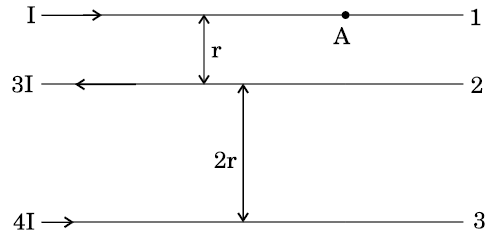
  1. magnitude and direction of the net magnetic field at point A lying on conductor 1,
  2. magnetic force on conductor 2.

Answer

  1. $B_2=\frac{\mu_0}{4\pi}\frac{2(3I)}{r}=\frac{\mu_0}{4\pi}\big(\frac{6I}{r}\big)$into the plane of the paper/$(\otimes)$.

$B_3=\frac{\mu_0}{4\pi}\frac{2(4I)}{3r}=\frac{\mu_0}{4\pi}\big(\frac{8I}{3r}\big)$out of the plane of the paper/$(\bigodot)$.

$B_A=B_2-B_3$ into the paper.

$=\frac{\mu_0}{4\pi}\Big(\frac{10I}{3r}\Big) into\text{ }the\text{ }paper.\text{} (\otimes)$

  1. $F_{21}=\frac{\mu_0}{4\pi}\frac{2I(3I)}{r}$ away from wire1 (/towards 3)

$F_{23}=\frac{\mu_0}{4\pi}\frac{2(3I)(4I)}{2r}$ away from wire 3 (towards 1)

$F_{\text{net}}=F_{23}-F_{21}$ towards wire1

$=\frac{\mu_0}{4\pi}\frac{6(I)^2}{r}$ towards wire1

Need a full question paper?

Generate a complete, print-ready paper with questions like this in minutes — across 16+ boards, with answer keys.

Start Generating Free

Similar questions

A ball is dropped from a height. If it takes 0.200s to cross the last 6.00m before hitting the ground, find the height from which it was dropped. Take g = 10m/s2.
Answer the following questions: When viewing through a compound microscope, our eyes should be positioned not on the eyepiece but a short distance away from it for best viewing. Why? How much should be that short distance between the eye and eyepiece?
A zener diode is fabricated by heavily doping both p- and n- sides of the junction. Explain, why? Briefly explain the use of zener diode as a de voltage regulator with the help of a circuit diagram.
A 100W light bulb is placed at the centre of a spherical chamber of radius 20cm. Assume that 60% of the energy supplied to the bulb is converted into light and that the surface of the chamber is perfectly absorbing. Find the pressure exerted by the light on the surface of the chamber.
  1. Depict the equipotential surfaces for a system of two identical positive point charges placed a distance ‘d’ apart.
  2. Deduce the expression for the potential energy of a system of two point charges q1 and q2 brought from infinity to the points$\overrightarrow{\text{r}_{1}}$  and $\overrightarrow{\text{r}_{2}}$ respectively in the presence of external electric field $\overrightarrow{\text{E}}.$
The given graph shows the variation of photo-electric currently) with the applied voltage(V) for two different materials and for two different intensities of the incident radiations. Identify and explain using Einstein's photo electric equation the pair of curves that correspond to (i) different materials but same intensity of incident radiation (ii) different intensities but same materials.

A galvanometer coil has a resistance of 15 Ω and the metre shows full scale deflection for a current of 4 mA. How will you convert the metre into an ammeter of range 0 to 6 A?
Explain two  main important points for astronomical telescope.
Consider a head-on collision between two particles of masses m1 and m2. The initial speeds of the particles are u1 and u2 in the same direction. The collision starts 2 at t = 0 and the particles interact for a time interval $\triangle\text{t}.$ During the collision, the speed of the first particle varies as.

$\text{v}(\text{t})=\text{u}_1+\frac{\text{t}}{\triangle\text{t}}(\text{v}_1-\text{u}_1).$

Find the speed of the second particle as a function of time during the collision.

In a Quincke's experiment, the sound intensity has a minimum value I at a particular position. As the sliding tube is pulled out by a distance of 16.5mm, the intensity increases to a maximum of 9I. Take the speed of sound in air to be 330m/s.
  1. Find the frequency of the sound source.
  2. Find the ratio of the amplitudes of the two waves arriving at the detector assuming that it does not change much between the positions of minimum intensity and maximum intensity.