MCQ
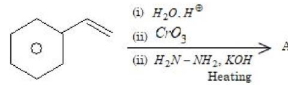
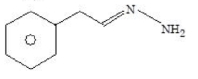
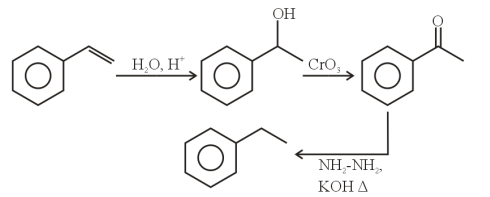
The final product $A$ formed in the following multistep reaction sequence is
- ✓
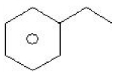
- B
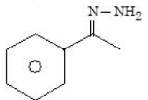
- C
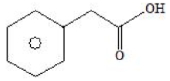
- D
Generate a complete, print-ready paper with questions like this in minutes — across 16+ boards, with answer keys.
${image}$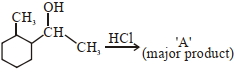
$(a)$ $2N_2O_5\rightarrow\,\,4NO_2(g)+O_2(g)-\frac{d[N_2O_5]}{dt}=k[N_2O_5]$
$(a)$ $N_2O_5\rightarrow\,\,2NO_2(g)+1/2\,\,O_2(g)-\frac{d[N_2O_5]}{dt}=k'[N_2O_5]$
which of the following is true ?
$(I)$ $ZnCl_2$ is ionic whereas $CdCl_2$ and $HgCl_2$ are covalent
$(II)$ $Zn$ and $Cd$ dissolves in dilute acid $(HCl)$ liberating $H_2$ but $Hg$ can not
$(III)$ $Zn$ and $Cd$ forming with ppt. of $Zn(OH)_2$ and $Cd(OH)_2$ but $Hg$ forms coloured ppt. of
$(IV)$ all from $A_2^{2+}$ type ion
$\mathrm{Zn}(\mathrm{s})+\mathrm{Cu}^{2+}(0.02 \mathrm{M}) \rightarrow \mathrm{Zn}^{2+}(0.04 \mathrm{M})+\mathrm{Cu}(\mathrm{s})$
$\mathrm{E}_{\text {cell }}=...... \,\times 10^{-2} \,\mathrm{~V} { (Nearest integer) }$
${\left[\text { Use }: \mathrm{E}_{\mathrm{Cu} / \mathrm{Cu}^{2+}}^{0}=-0.34\, \mathrm{~V}, \mathrm{E}_{2 \mathrm{n} / \mathrm{Zn}^{2+}}^{0}=+0.76 \,\mathrm{~V}\right.}$
$\left.\frac{2.303 \mathrm{RT}}{\mathrm{F}}=0.059\, \mathrm{~V}\right]$
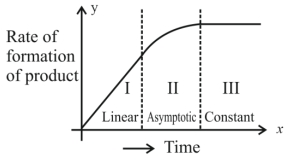
$(A)$ Over all order of this reaction is one
$(B)$ Order of this reaction can't be determined
$(C)$ In region$-I$ and $III$, the reaction is of first and zero order respectively
$(D)$ In region$-II$, the reaction is of first order
$(E)$ In region$-II$, the order of reaction is in the range of $0.1$ to $0.9$.