MCQ
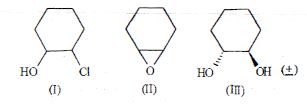
The final product $(III)$ is

  • A
    Epoxycydohexane
  • B
    $2-$ Chlorocylohexanol
  • C
    $(±)$ Cis $- 1\,,2-$ cyclohexanediol
  • Trans $- 1,\, 2- $cyclohexanediol

Answer

Correct option: D.
Trans $- 1,\, 2- $cyclohexanediol
d

Need a full question paper?

Generate a complete, print-ready paper with questions like this in minutes — across 16+ boards, with answer keys.

Start Generating Free

Similar questions

Following limiting molar conductivities are given as

$\lambda_{\mathrm{m}\left(\mathrm{H}_{2} \mathrm{SO}_{4}\right)}^{0}=\mathrm{x} \;\mathrm{S}\; \mathrm{cm}^{2} \mathrm{mol}^{-1}$

$\lambda_{\mathrm{m}\left(\mathrm{K}_{2} \mathrm{SO}_{4}\right)}^{0}=\mathrm{y} \;\mathrm{S\;cm}^{2} \mathrm{mol}^{-1}$

$\lambda_{\mathrm{m}(\mathrm{CH_3} \mathrm{COOK})}^{0}=\mathrm{z}\; \mathrm{S\;cm}^{2} \mathrm{mol}^{-1}$

$\lambda_{\mathrm{m}}^{0}\left(\mathrm{in}\; \mathrm{S} \;\mathrm{cm}^{2} \mathrm{mol}^{-1}\right)$ for $\mathrm{CH}_{3} \mathrm{COOH}$ will be

On passing $96500$ coulomb of charge through a solution $CuS{O_4}$ the amount of copper liberated is
In a set of reactions $m-$bromobenzoic acid gave a product $D.$ Identify the product $D.$

(image) $\xrightarrow{{SOC{l_2}}}\,B\,\xrightarrow{{N{H_3}}}\,C$$\,\xrightarrow[{B{r_2}}]{{NaOH}}\,D$
Compound which decarboxylate on gentle heating
Grignard reagents do not give carbonyl compounds with :
Complete removal of both the axial ligands (along the $z-$ axis) from an octahedral complex leads to which of the following splitting patterns? (relative orbital energies not on scale)
One mole of glucose is dissolved in $2\, moles$ of water. The vapour pressure of solution relative to that of water is
Benzene hexachloride $ (BHC$) is used as
Which of the following product will be obtained in the given (consider minor  product also) Beckman $n-$ type rearrangement ?
The difference between the electrode potentials of two electrodes when no current is drawn through the cell is called ___________.