MCQ
The first ionisation potential is maximum for
  • A
    $B$
  • $N$
  • C
    $O$
  • D
    $Be$

Answer

Correct option: B.
$N$
b
(b) Ionisation potential generally increases when we more in a period from left to right but $I{E_1}$ of ${N_2}$ is greater than that of ${O_2}$.

It is due to the more stable (half-filled orbitals) configurations of $N$.

Need a full question paper?

Generate a complete, print-ready paper with questions like this in minutes — across 16+ boards, with answer keys.

Start Generating Free

Similar questions

Compound having least heat of hydrogenation
The $IUPAC$ name of $C{H_2} = CH - C{H_2}Cl$ is
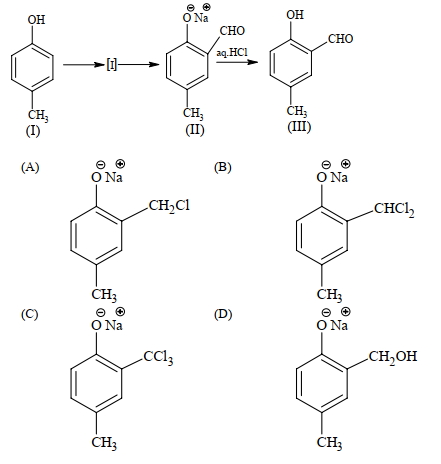
Reimer-Tiemann reaction introduces an aldehyde group, on to the aromatic ring of phenol, ortho to the hydroxyl group. This reaction involves electrophilic aromatic substitution. This is a general method for the synthesis of substituted salicyladehydes as depicted below.

$Image$

$1.$ Which one of the following reagents is used in the above reaction?

$(A)$ aq. $\mathrm{NaOH}+\mathrm{CH}_3 \mathrm{Cl}$

$(B)$ aq. $\mathrm{NaOH}+\mathrm{CH}_2 \mathrm{Cl}_2$

$(C)$ aq. $\mathrm{NaOH}+\mathrm{CHCl}_3$

$(D)$ aq. $\mathrm{NaOH}+\mathrm{CCl}_4$

$2.$ The electrophile in this reaction is

$(A)$ : $\mathrm{CHCl}$ $(B)$ ${ }^{+} \mathrm{CHCl}_2$

$(C)$ $\mathrm{CCl}_2$ $(D)$. $\mathrm{CCl}_3$

$3.$ The structure of the intermediate $I$ is

$Image$

Give the answer question $1, 2$ and $3.$
Complete combustion of $750\, g$ of an organic compound provides $420\, g$ of $CO _{2}$ and $210\, g$ of $H _{2} O$. The percentage composition of carbon and hydrogen in organic compound is $15.3$ and ............. respectively. (Round off to the Nearest Integer)
Which molecule does not show zero dipole moment
$1\,g$ metal nitrate produces $0.86\, g$ of metal sulphate then equivalent weight of metal will be
$12\,g$ of $Mg$ (at. mass $24$) will react completely with acid to give
Product $Z$ of above reaction is
Which of the following gives primary amine on reduction
Which of the following complex ion has a magnetic moment same as $[Cr(H_2O)_6]^{3+}$ ?