Question
The first ionisation potential is maximum for

Answer

b
(b) Ionisation potential generally increases when we more in a period from left to right but $I{E_1}$ of ${N_2}$ is greater than that of ${O_2}$.

It is due to the more stable (half-filled orbitals) configurations of $N$.

Need a full question paper?

Generate a complete, print-ready paper with questions like this in minutes — across 16+ boards, with answer keys.

Start Generating Free

Similar questions

Which of the following is not an aromatic compound :
Arrange the above in the decreasing order of reactivity towards $HBr.$
The ground state energy of hydrogen atom is $-13.6 eV$. Consider an electronic state $\Psi$ of $He ^{-}$whose energy, azimuthal quantum number and magnetic quantum number are $-3.4 eV , 2$ and $0$ respectively. Which of the following statement($s$) is(are) true for the state $\Psi$ ?

$(1)$ It has $2$ angular nodes

$(2)$ It has $3$ radial nodes

$(3)$ It is a 4d state

$(4)$ The nuclear charge experienced by the electron in this state is less than $2 e$, where $e$ is the magnitude of the electronic charge.

The first order rate constant for the decomposition of $\mathrm{CaCO}_{3}$ at $700\, \mathrm{~K}$ is $6.36 \times 10^{-3}\, \mathrm{~s}^{-1}$ and activation energy is $209\, \mathrm{~kJ} \,\mathrm{~mol}^{-1}$. Its rate constant (in $\mathrm{s}^{-1}$ ) at $500\, \mathrm{~K}$ is $\mathrm{x} \times 10^{-6}$. The value of $\mathrm{x}$ is ..... . Nearest integer)

Given $\mathrm{R}=8.31\, \mathrm{~J} \,\mathrm{~K}^{-1} \,\mathrm{~mol}^{-1} ; \log 6.36 \times 10^{-3}=-2.19$ $\left.10^{-4.79}=1.62 \times 10^{-5}\right]$
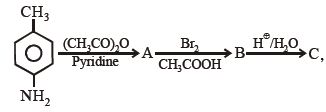
$C$ will be
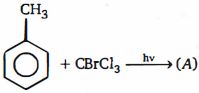
(no ring substitution) Product $(A)$ is
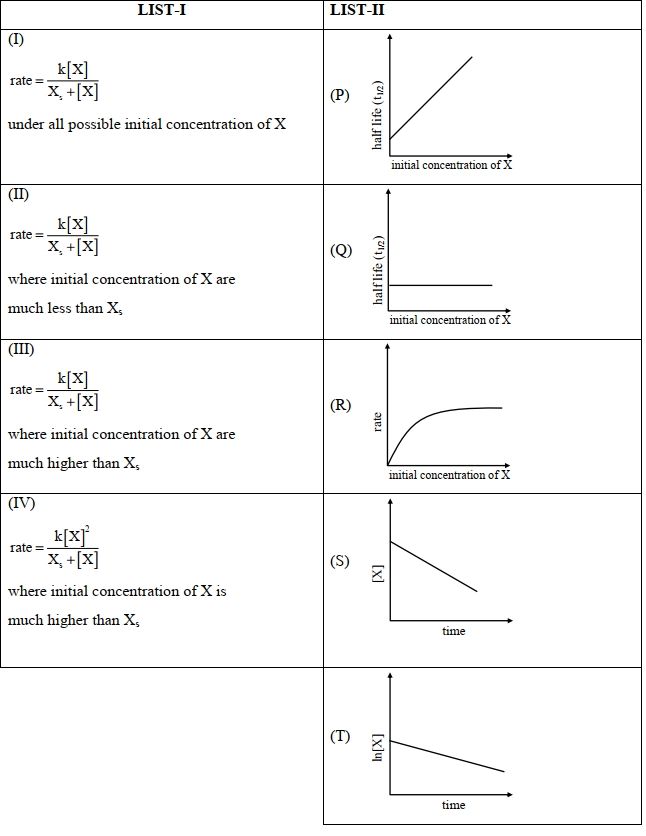
Match the rate expressions in $LIST-I$ for the decomposition of $X$ with the corresponding profiles provided in $LIST-II$. $X _5$ and $k$ constants having appropriate units.
In which of the following reaction cyanide will be obtained as a major product ?
Incorrect $IUPAC$ name is
The solubility of ${I_2}$ increases in water in the presence of