Question
The first ionization enthalpies of four consecutive elements present in the second period of the periodic table are $8.3, 11.3, 14.5$ and $13.6\,\, eV,$  respectively. Which one of the following is the first ionization enthalpy of nitrogen ?

Answer

b
Elements in the 2nd period are: Period Elements II nd

Li Be BC N O F Nel In a period from left to right, ionization potential increases. But in case of nitrogen

and oxygen, nitrogen has more ionization potential than oxygen atom due to stable electronic configuration of nitrogen. $7 N=1 s^{2}, 2 s^{2} 2 p^{3} \mid$

$\uparrow\|\| \|$

(Stable configuration) $80=1 s^{2}, 2 s^{2} 2 p^{4}$ (Unstable configuration) Nitrogen has stable configuration as

the p-orbitals are half-filled completely. So, more energy is required to remove an electron from the outermost orbit of nitrogen atom. So, $\mathrm{N}_{2}$, has 14.5 value of ionisation potential.

Need a full question paper?

Generate a complete, print-ready paper with questions like this in minutes — across 16+ boards, with answer keys.

Start Generating Free

Similar questions

Consider the two different first order reactions given below

$\mathrm{A}+\mathrm{B} \rightarrow \mathrm{C}$ (Reaction 1$)$

$\mathrm{P} \rightarrow \mathrm{Q}$ (Reaction $2$)

The ratio of the half life of Reaction $1$ : Reaction $2$ is $5: 2$. If $t_1$ and $t_2$ represent the time taken to complete $2 / 3^{\text {dd }}$ and $4 / 5^{\text {dd }}$ of Reaction $1$ and

Reaction $2$, respectively, then the value of the ratio $\mathrm{t}_1: \mathrm{t}_2$ is . . . .$\times 10^{-1}$ (nearest integer).

[Given: $\log _{10}(3)=0.477$ and $\log _{10}(5)=0.699$ ]

Product of the reaction is
The process requiring the absorption of energy is
A hydride of nitrogen which is acidic is
Three substances $A, B$ and $C$ can react to form $E$ and $D$ as shown $2A + 3B + C \rightarrow  4D + 2E$  If molar masses of  $A,B,C$ and $D$ are $40, 30, 20$ and $15$ respectively and $570\  gm$ of mixture of $A, B$ & $C$ is reacted then maximum mass of $E$ which can be obtained will be ............ $\mathrm{gm}$
Ethene gives with acidic $KMn{O_4}$ solution
Which of the following is correct ?
Select incorrect statement
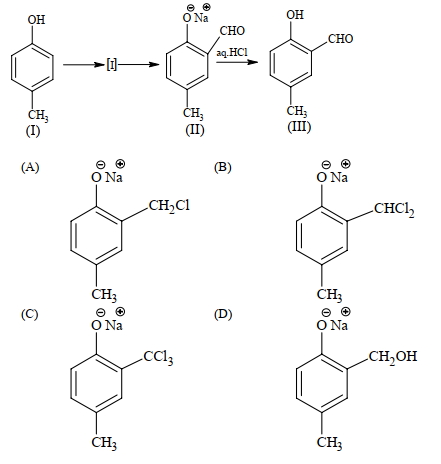
Reimer-Tiemann reaction introduces an aldehyde group, on to the aromatic ring of phenol, ortho to the hydroxyl group. This reaction involves electrophilic aromatic substitution. This is a general method for the synthesis of substituted salicyladehydes as depicted below.

$Image$

$1.$ Which one of the following reagents is used in the above reaction?

$(A)$ aq. $\mathrm{NaOH}+\mathrm{CH}_3 \mathrm{Cl}$

$(B)$ aq. $\mathrm{NaOH}+\mathrm{CH}_2 \mathrm{Cl}_2$

$(C)$ aq. $\mathrm{NaOH}+\mathrm{CHCl}_3$

$(D)$ aq. $\mathrm{NaOH}+\mathrm{CCl}_4$

$2.$ The electrophile in this reaction is

$(A)$ : $\mathrm{CHCl}$ $(B)$ ${ }^{+} \mathrm{CHCl}_2$

$(C)$ $\mathrm{CCl}_2$ $(D)$. $\mathrm{CCl}_3$

$3.$ The structure of the intermediate $I$ is

$Image$

Give the answer question $1, 2$ and $3.$
Which bond angle $\theta $ would result in the maximum dipole moment for the triatomic molecule $YXY$