MCQ
The first ionization enthalpies of four consecutive elements present in the second period of the periodic table are $8.3, 11.3, 14.5$ and $13.6\,\, eV,$  respectively. Which one of the following is the first ionization enthalpy of nitrogen ?
  • A
    $13.6$
  • $14.5$
  • C
    $11.3$
  • D
    $8.3$

Answer

Correct option: B.
$14.5$
b
Elements in the 2nd period are: Period Elements II nd

Li Be BC N O F Nel In a period from left to right, ionization potential increases. But in case of nitrogen

and oxygen, nitrogen has more ionization potential than oxygen atom due to stable electronic configuration of nitrogen. $7 N=1 s^{2}, 2 s^{2} 2 p^{3} \mid$

$\uparrow\|\| \|$

(Stable configuration) $80=1 s^{2}, 2 s^{2} 2 p^{4}$ (Unstable configuration) Nitrogen has stable configuration as

the p-orbitals are half-filled completely. So, more energy is required to remove an electron from the outermost orbit of nitrogen atom. So, $\mathrm{N}_{2}$, has 14.5 value of ionisation potential.

Need a full question paper?

Generate a complete, print-ready paper with questions like this in minutes — across 16+ boards, with answer keys.

Start Generating Free

Similar questions

Given that $\Delta {T_f}$ is the depression in freezing point of the solvent in a solution of a non-volatile solute of molality $m$, the quantity $\mathop {\lim }\limits_{m \to 0} \left( {\frac{{\Delta {T_f}}}{m}} \right)$ is equal to
The major product ($Y$) in the following reactions is

$\begin{array}{*{20}{c}}
  {C{H_3}\,\,\,\,\,\,\,\,\,} \\ 
  {|\,\,\,\,\,\,\,\,\,\,\,\,\,\,} \\ 
  {C{H_3} - CH - C = CH} 
\end{array}\xrightarrow[{{H_2}O}]{{HgS{O_4},{H_2}S{O_4}}}X$ $\xrightarrow[{(ii)\,conc.{H_2}S{O_4}/\Delta }]{{(i)\,{C_2}{H_5}MgBr,{H_2}O}}Y$

$1-$butyne reacts with cold alkaline $KMn{O_4}$ to produce
Among the following, the reaction that proceeds through an electrophilic substitution is
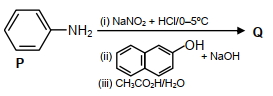
Consider the reaction sequence from $P$ to $Q$ shown below. The overall yield of the major product $Q$ from $P$ is $75 \%$. What is the amount in grams of $Q$ obtained from $9.3 mL$ of $P$ ? (Use density of $P =1.00 g mL ^{-1}$, Molar mass of $C =12.0, H =1.0, O =16.0$ and $N =14.0 g mol ^{-1}$ )
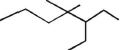
The $IUPAC$ name of 
Ethanol and $HCO_2H$ can't be distinguished by
$3- $ pentanol is a
Considering acetic acid dissociates in water, its dissociation constant is $6.25 \times 10^{-5}$. If $5 \mathrm{~mL}$ of acetic acid is dissolved in $1$ litre water, the solution will freeze at $-\mathrm{x} \times 10^{-2}{ }^{\circ} \mathrm{C}$, provided pure water freezes at $0^{\circ} \mathrm{C}$.

$\mathrm{x}=$ . . . . . . . . . (Nearest integer)

Given : $\left(\mathrm{K}_{\mathrm{r}}\right)_{\text {water }}=1.86 \mathrm{~K} \mathrm{~kg} \mathrm{~mol}^{-1}$.

density of acetic acid is $1.2 \mathrm{~g} \mathrm{~mol}^{-1}$

molar mass of water $=18 \mathrm{~g} \mathrm{~mol}^{-1}$.

molar mass of acetic acid $=60 \mathrm{~g} \mathrm{~mol}^{-1}$.

density of water $=1 \mathrm{~g} \mathrm{~cm}^{-3}$

Acetic acid dissociates as

$\mathrm{CH}_3 \mathrm{COOH} \rightleftharpoons \mathrm{CH}_3 \mathrm{COO}^{\oplus}+\mathrm{H}^{\oplus}$

From the given set of species, point out the species from each set having least atomic radius 

$(A)\, F^-, Na^+, Mg^{+2}$              $(B) \,Ni, Cu, Zn$
$(C)\, N^{-3}, Cs^+, H^-$                $(D)\, Li, He, Be^{+2}$