MCQ
The first term of a $G.P.$ whose second term is $2$ and sum to infinity is $8$, will be
  • A
    $6$
  • B
    $3$
  • $4$
  • D
    $1$

Answer

Correct option: C.
$4$
c
(c) We have $ar = 2$ and ${S_\infty } = 8 = \frac{a}{{1 - r}}$

$ \Rightarrow $ $8 = \frac{2}{{r(1 - r)}}\left( {\;a = \frac{2}{r}} \right)$

$ \Rightarrow $ $4r(1 - r) = 1 $

$\Rightarrow 4r - 4{r^2} - 1 = 0$

$ \Rightarrow $ $4{r^2} - 4r + 1 = 0$

$\Rightarrow \left( {r - \frac{1}{2}} \right)(4r - 2) = 0$

$\Rightarrow r = \frac{1}{2}$

So first term $a = 4$.

Need a full question paper?

Generate a complete, print-ready paper with questions like this in minutes — across 16+ boards, with answer keys.

Start Generating Free

Similar questions

Which of the following is(are) $NOT$ the square of a $3 \times 3$ matrix with real entries ?

$[A]$ $\left[\begin{array}{ccc}1 & 0 & 0 \\ 0 & 1 & 0 \\ 0 & 0 & -1\end{array}\right]$

$[B]$ $\left[\begin{array}{ccc}-1 & 0 & 0 \\ 0 & -1 & 0 \\ 0 & 0 & -1\end{array}\right]$

$[C]$ $\left[\begin{array}{lll}1 & 0 & 0 \\ 0 & 1 & 0 \\ 0 & 0 & 1\end{array}\right]$

$[D]$ $\left[\begin{array}{ccc}1 & 0 & 0 \\ 0 & -1 & 0 \\ 0 & 0 & -1\end{array}\right]$
Define $g(x)=\int \limits_{-3}^3 f(x-y) f(y) d y$, for all real $x$, where $f(t)=\left\{\begin{array}{ll}1, & 0 \leq t \leq 1 \\ 0, & \text { else where }\end{array}\right.$ Then,
If ${I_n} = \int {{{(\log x)}^n}\,\,dx} ,$ then ${I_n} + n{I_{n - 1}} = $
$\mathop {\lim }\limits_{x \to \infty } {\left( {\frac{{x + 3}}{{x + 1}}} \right)^{x + 1}} = $
If ${S_1},\;{S_2},\;{S_3},...........{S_m}$ are the sums of $n$ terms of $m$ $A.P.'s$ whose first terms are $1,\;2,\;3,\;...............,m$ and common differences are $1,\;3,\;5,\;...........2m - 1$ respectively, then ${S_1} + {S_2} + {S_3} + .......{S_m} = $
The number of ways in which $5$ male and $2$ female members of a committee can be seated around a round table so that the two female are not seated together is
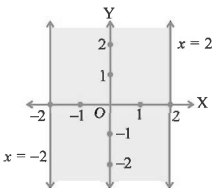
The inequality representing the coloured region in figure is $\ldots \ldots . .$
If the system of equations  $2 x+3 y-z=5$  ;  $x+\alpha y+3 z=-4$  ;  $3 x-y+\beta z=7$ has infinitely many solutions, then $13 \alpha \beta$ is equal to
If $\omega $is a cube root of unity, then $\left| {\,\begin{array}{*{20}{c}}{x + 1}&\omega &{{\omega ^2}}\\\omega &{x + {\omega ^2}}&1\\{{\omega ^2}}&1&{x + \omega }\end{array}\,} \right| = $
The value of the limit $\lim _{\theta \rightarrow 0} \frac{\tan \left(\pi \cos ^{2} \theta\right)}{\sin \left(2 \pi \sin ^{2} \theta\right)}$ is equal to :