Question
The following data was recorded for values of object distance and the corresponding values of image distance in the experiment on study of real image formation by a convex lens of power +5D. One of these observations is incorrect. Identify this observation and give reason for your choice:
S .No
Object distance (cm)
Image distance (cm)
1
25
97
2
30
61
3
35
37
4
45
35
5
50
32
6
55
30

Answer

Power of lens = +5D
Focal length of lens,
The observations at serial number (3) i.e., (object distance 35cm and image distance 37cm is incorrect), because if the object is placed at a distance between f and 2f its image will be formed beyond 2f, while in this observation the object and image distances, both are between f and 2f.

Need a full question paper?

Generate a complete, print-ready paper with questions like this in minutes — across 16+ boards, with answer keys.

Start Generating Free

Similar questions

What physical quantity is the same for $X-$rays of wavelength $10^{-10} m,$ red light of wavelength $6800 \mathring A$ and radiowaves of wavelength $500m$?
A proton has spin and magnetic moment just like an electron. Why then its effect is neglected in magnetism of materials?
  1. State Faraday’s law of electromagnetic induction.
  2. A jet plane is travelling towards west at a speed of $1800 \ km/h$. What is the voltage difference developed between the ends of the wing having a span of $25 m,$ if the Earth’s magnetic field at the location has a magnitude of $5 x 10^{–4} T$ and the dip angle is $30^\circ$ ?
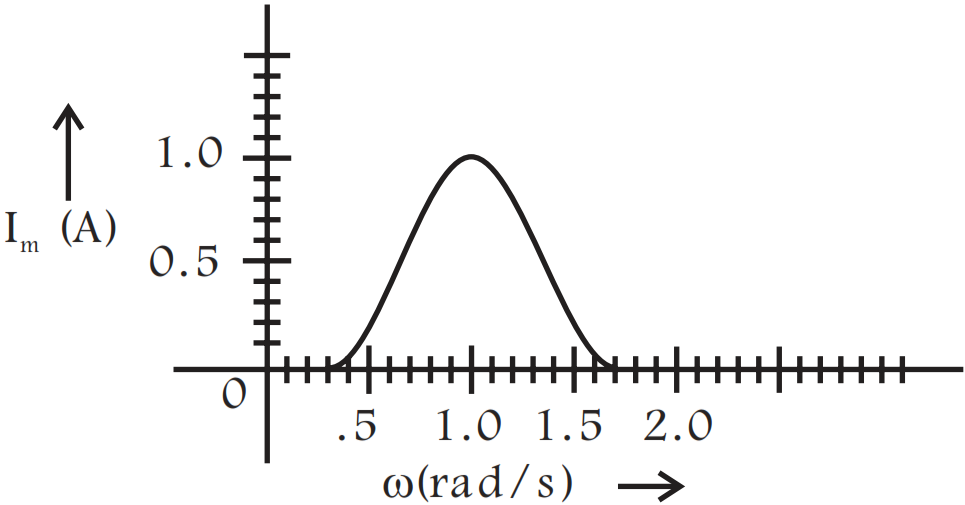
In series $\text{LCR}$ circuit, the plot of $I_{max}$ vs $\omega$ is shown in Fig. Find the bandwidth and mark in the figure.
$5g$ of a gas is contained in a rigid container and is heated from $15^\circ C$ to $25^\circ C$. Specific heat capacity of the gas at constant volume is $0.172cal-g^{-1}^\circ C^{-1}$ and the mechanical equivalent of heat is $4.2J-cal^{-1}$. Calculate the change in the internal energy of the gas.
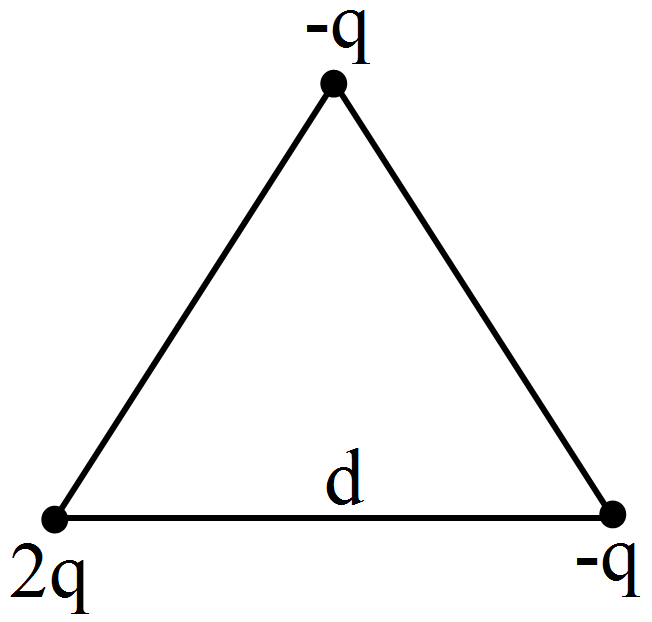
Three charges are arranged on the vertices of an equilateral triangle as shown in figure. Find the dipole moment of the combination.
Can we have magnetic hysteresis in paramagnetic or diamagnetic substances?
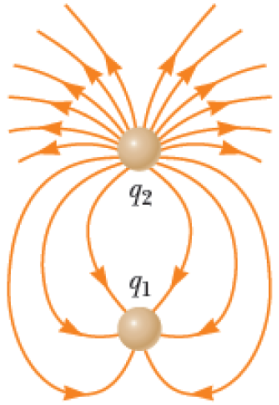
Consider the situation shown in figure. What are the signs of $q_1$ and $q_2$? If the lines are drawn in proportion to the charge, what is the ratio $\frac{\text{q}_1}{\text{q}_2}?$
How does the resolving power of a compound microscope get affected on:
  1. Decreasing the diameter of its objective?
  2. Increasing the focal length of its objective?
A $2$ in long string fixed at both ends is set into vibrations in its first overtone. The wave speed on the string is $200m/s$ and thee amplitude is $0.5\ cm.$
  1. Find the wavelength and the frequency.
  2. Write the equation giving the displacement of different points as a function of time. Choose the $X-$axis along the string with the origin at one end and $t = 0$ at the instant when the point $x = 50\ cm$ has reached its maximum displacement.