Question
The following equation represents standing wave set up in medium,
$\text{y}=4\cos\frac{\pi\text{x}}{5}\sin40\pi\text{t},$
where x and y are in cm and t in sec. Find out the amplitude and the velocity of the two component waves and calculate the distance between adjacent nodes. What is the velocity of a medium particle at x = 3cm at time $\frac{1}{8}\text{sec}$?

Answer

The given equation of stationary wave is
$\text{y}=4\cos\frac{\pi\text{x}}{3}\sin40\pi\text{t}$
or $\text{y}=2\times2\cos\frac{2\pi\text{x}}{6}\sin\frac{2\text{x}(120)\text{t}}{6}\ \dots{\text{(i)}}$
We know that $\text{y}=2\text{a}\cos\frac{2\pi\text{x}}{\lambda}\sin\frac{2\text{x}v\text{t}}{\lambda}\ \dots(\text{i})$
By comparing tow equations, we get
$\text{a}=2\text{cm}, \lambda=6\text{cm}$ and $v=220\text{cm/ sec}.$
The component waves are:
$\text{y}_1=\text{a}\sin\frac{2\pi}{\lambda}(v\text{t}-\text{x})$ and $\text{y}_2=\text{a}\sin\frac{2\pi}{\lambda}(v\text{t}+\text{x})$
Distance between two adjacent nodes $=\frac{\lambda}{2}=\frac{6}{2}=3\text{cm}.$
Particle velocity $\frac{\text{dy}}{\text{dt}}=4\cos\frac{\pi\text{x}}{3}\cos(40\pi\text{t}).40\pi$
$=160\cos\frac{\pi\text{x}}{3}\cos40\pi\text{t}$
$=160\pi\cos\frac{\pi\text{x}}{3}\cos\Big(40\pi\times \frac{1}{8}\Big)​​=160 \pi$ $[\because \cos\pi=\cos5\pi=-1]$
Hence, particle velocity = 160cm/ sec.

Need a full question paper?

Generate a complete, print-ready paper with questions like this in minutes — across 16+ boards, with answer keys.

Start Generating Free

Similar questions

Three equal charges, 2.0 × 10-6C each, are held fixed at the three corners of an equilateral triangle of side 5cm. Find the Coulomb force experienced by one of the charges due to the rest two.
A carnot engine with the cold body temperature of 17°C has 50% efficiency. By how much should the temperature of its hot body be changed to increase the efficiency to 60%? When will its efficiency be 100%?
Figure shows a 11.7ft wide ditch with the approach roads at an angle of 15° with the horizontal. With what minimum speed should a motorbike be moving on the road so that it safely crosses the ditch?
Assume that the length of the bike is 5ft, and it leaves the road when the front part runs out of the approach road.

Two strips of metal are riveted together at their ends by four rivets, each of diameter 6.0mm. What is the maximum tension that can be exerted by the riveted strip if the shearing stress on the rivet is not to exceed 6.9 × 10⁷ Pa? Assume that each rivet is to carry one quarter of the load.
Two mercury droplets of radii 0.1 cm . and 0.2 cm . collapse into one single drop. What amount of energy is released? The surface tension of mercury $T =435.5 \times 10^{-3} N m ^{-1}$.
  1. Write ideal gas equation in terms of density.
  2. If molar volume is the volume occupied by 1 mole of any (ideal) gas at STP, show that it is 22.4L (take R = 8.313 mol-1 K-1).
Define thermal conduction. Briefly explain its molecular mechanism.
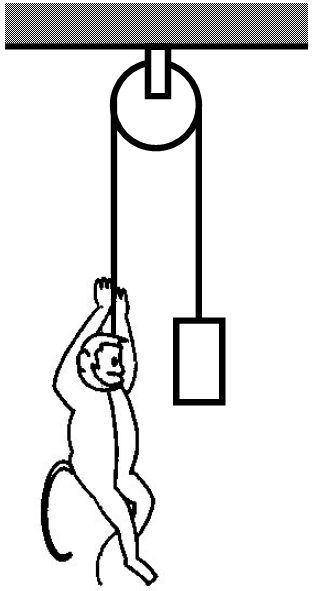
A monkey is climbing on a rope that goes over a smooth light pulley and supports a block of equal mass at the other end figure. Show that whatever force the monkey exerts on the rope, the monkey and the blockmove in the same direction with equal acceleration. If initially both were at rest, their separation will not change as time passes.

Two rods of the same area of cross-section, but of lengths l, and l, and conductivities K, and K, are joined in series. Show that the combination is equivalent of a material of conductivity
$\text{K}=\frac{\text{l}_1+\text{l}_2}{\Big(\frac{\text{l}_1}{\text{K}_1}\Big)+\Big(\frac{\text{l}_2}{\text{l}_2}\Big)}$
Two small balls A and B, each of mass m, are joined rigidly by a light horizontal rod of length L. The rod is clamped at the centre in such a way that it can rotate freely about a vertical axis through its centre. The system is rotated with an angular speed w about the axis. A particle P of mass m kept at rest sticks to the ball A as the ball collides with it. Find the new angular speed of the rod.