Question
The following information is available about defective staplers after testing $50$ packets of $500$ staplers each. Find coefficient of skewness using Karl Pearson’s method.
No. of defective staplers $19$ $20$ $21$ $22$ $23$ $24$ $25$ $26$
No. of packets $5$ $18$ $10$ $8$ $4$ $2$ $2$ $1$

Answer

No. of defective staplers $x$ No. of packets $f$ $d = (x – A)
A = 22$
$fd$ $fd^2 = fd.d$
$19$ $5$ $-3$ $-15$ $45$
$20$ $18$ $-2$ $-36$ $72$
$21$ $10$ $-1$ $-10$ $10$
$22$ $8$ $0$ $0$ $0$
$23$ $4$ $1$ $4$ $4$
$24$ $2$ $2$ $4$ $8$
$25$ $2$ $3$ $6$ $18$
$26$ $1$ $4$ $4$ $16$
Total $n = 50$ - $18 - 61$
$\sum f d = -43$
$\sum f d^2=173$
Mean :
$s=\sqrt{\frac{\sum fd ^2}{ n }-\left(\frac{\sum fd }{ n }\right)^2}$
$=22-\frac{43}{50}$
$=22-0.86$
$=21.14$ packets
Mode :
$M _0=$ The observation having maximum frequency $18 =20$ packets
Standard deviation :
$s =\sqrt{\frac{\sum fd ^2}{ n }-\left(\frac{\sum fd }{ n }\right)^2}$
$ =\sqrt{\frac{173}{50}-\left(\frac{-43}{50}\right)^2}$
$ =\sqrt{3.46-(-0.86)^2}$
$ =\sqrt{3.46-0.7396}$
$ =\sqrt{2.7204}$
$ =1.65$ packets
Coefficient of skewness by karl pearson's
method:
$j =\frac{\overline{\bar{x}}- M _0}{8}$
$=\frac{21.14-20}{1.65}$
$=\frac{1.14}{1.65}$
$\therefore j =0.69$

Need a full question paper?

Generate a complete, print-ready paper with questions like this in minutes — across 16+ boards, with answer keys.

Start Generating Free

Similar questions

If $S _{16}=17 S _4$ for a $G. P.$, find the common ratio.
The total cost function for a factory is $y = 10 + 3x$ where $x = No$. of units produced and $y =$ total cost of producing $x$ units. The range, the quartile deviation, the mean deviation and standard deviation of daily production of the factory are $50, 5, 8$ and $10$ units respectively. Find the range quartile deviation mean deviation and standard deviation for total cost y from it.

Image
The data about weight (in grams) of mangoes from a tree are as follows. Moreover, the minimum weight for these mangoes is $410$ grams. Find the mean weight of mangoes.
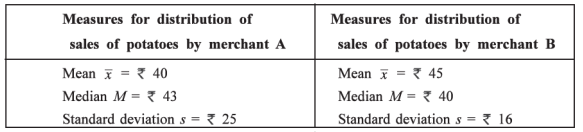
From the following measures obtained for the frequency distributions of sales (in lakh Rs.) of potatoes by two merchants in a month, determine which distribution is more close to symmetry.
Obtain an inclusive continuous frequency distribution from the following data.
Lower boundary point or more than that
$44.5$
$49.5$
$54.5$
$59.5$
$64.5$
$69.5$
$74.5$
$79.5$
Cumulative frequency
$500$
$470$
$390$
$290$
$240$
$90$
$10$
$0$
Obtain the values using binomial expansion: $(\sqrt{2}+$ 1) $^{6}+(\sqrt{2}-1)^{6}$
The information of runs scored by a batsman in his $100$ matches is given below. Find the standard deviation of runs scored by him from it.
Runs $0 - 10$ $10 – 20$ $20 -30$ $30 – 40$ $40 – 50$ $50 – 60$ $60 – 70$
No. of matches $10$ $15$ $25$ $25$ $10$ $10$ $5$
Discuss the method of collecting primary data by indirect inquiry.
From the following data state which frequency distribution is close to symmetry.:
Frequency distribution $\mathrm{A}: \bar{x}=40, M=44, S=15$
Frequency distribution $\mathrm{B}: x=40, M=45, s=16$