MCQ
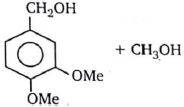
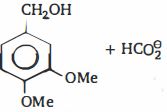
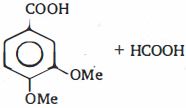
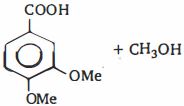
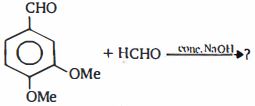
The following reaction gives
  • A


  • C

  • D

Answer

Correct option: B.

b
$(b)$ Cross Cannizzaro reaction.

Need a full question paper?

Generate a complete, print-ready paper with questions like this in minutes — across 16+ boards, with answer keys.

Start Generating Free

Similar questions

Match each of the reactions given in Column $I$ with the corresponding product$(s)$ given in Column $II$.
Column $I$ Column $II$
$(A)$ $\mathrm{Cu}+$ dil $\mathrm{HNO}_3$ $(p)$ NO
$(B)$ $\mathrm{Cu}+$ conc $\mathrm{HNO}_3$ $(q)$ $\mathrm{NO}_2$
$(C)$ $\mathrm{Zn}+$ dil $\mathrm{HNO}_3$ $(r)$ $\mathrm{N}_2 \mathrm{O}$
$(D)$ $\mathrm{Zn}+$ conc $\mathrm{HNO}_3$ $(s)$ $\mathrm{Cu}\left(\mathrm{NO}_3\right)_2$
  $(t)$ $ \mathrm{Zn}\left(\mathrm{NO}_3\right)_2$
If the concentration of glucose $\left(\mathrm{C}_{6} \mathrm{H}_{12} \mathrm{O}_{6}\right)$ in blood is $0.72\, \mathrm{~g} \,\mathrm{~L}^{-1}$, the molarity of glucose in blood is $.....\,\times 10^{-3} \mathrm{M}$. (Nearest integer)

(Given: Atomic mass of $\mathrm{C}=12, \mathrm{H}=1, \mathrm{O}=16 \mathrm{u}$ )

Identify a molecule which does not exist.
Number of sp hybridised carbon atom in the given compound is :

$C{H_2} = CH - C \equiv C - C{H_2} - CN$
The number of radial node/s for $3 \mathrm{p}$ orbital is:
The $IUPAC$ name of $\begin{array}{*{20}{c}}
  {CH - C - O - C{H_2} - C - OH} \\ 
  {||\,\,\,\,\,\,\,\,\,\,\,\,\,\,\,\,\,\,\,\,\,\,\,\,\,\,\,\,\,\,\,||} \\ 
  {O\,\,\,\,\,\,\,\,\,\,\,\,\,\,\,\,\,\,\,\,\,\,\,\,\,\,\,\,\,O} 
\end{array}$ is :
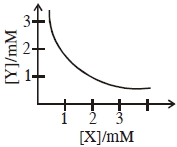
The stoichiometry and solubility product of a salt with the solubility curve given below is, respectively
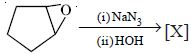
In the given reaction $[X]$ will be :
What will be the reduction potential of $Cu$ in aqueous solution with $pH = 12$ ? If $K_{sp}$ of $Cu(OH)_2$ is $1\times10^{-19}$ and $E_{C{u^{ + 2}}/Cu}^o = 0.34\,V$ ............. $\mathrm{V}$
On mixing ethyl acetate with aqueous sodium chloride, the composition of the resultant solution is