MCQ
The following square - planar complex shows cis - trans isomerism
  • A
    $PtCl_4^{-2}$
  • B
    $[PtCl_3(NH_3)]^-$
  • $[Pt Cl_2 (CN)_2]^{-2}$
  • D
    $[PtCl_2 (en)]$

Answer

Correct option: C.
$[Pt Cl_2 (CN)_2]^{-2}$
c

Need a full question paper?

Generate a complete, print-ready paper with questions like this in minutes — across 16+ boards, with answer keys.

Start Generating Free

Similar questions

$4$ moles of $A$ are mixed with $4$ moles of $B$. At equilibrium for the reaction $A + B$ $\rightleftharpoons$ $C + D$, $2 $ moles of $C$ and $D$ are formed. The equilibrium constant for the reaction will be
Urea upon hydrolysis yields
Consider the following statements

$(I)$ The radius of an anion is larger than that of the parent atom. 

$(II)$ The ionization energy generally increases with increasing atomic number  in a period.

$(III)$ The electronegativity of an element is the tendency of an isolated atom  to attract an electron.

Which of the above statements is/are correct?
Write the equilibrium constant $K$ for $C{H_3}COOH + {H_2}O = {H_3}{O^ + } + C{H_3}CO{O^ - }$
The oxidation number and the electronic configuration of sulphur in ${H_2}S{O_4}$ is
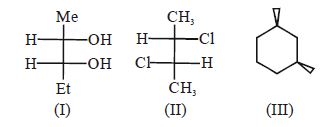
Which of the following are meso compounds
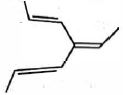
How many geometrical isomers are possible for the above compound ?
Consider the following reactions in which all the reactants and products are in gaseous state

${\text{2PQ}} \rightleftharpoons {{\text{P}}_2}{\text{  +  }}{{\text{Q}}_2}\,;\,\,\,\,{{\text{K}}_1}{\text{ =  2}}{\text{.5 }} \times \,{\text{1}}{{\text{0}}^5}\,$

${\text{PQ + }}\frac{1}{2}{R_2} \rightleftharpoons PQR\,;\,\,\,\,{{\text{K}}_2}{\text{ =  5 }} \times \,{\text{1}}{{\text{0}}^{ - 3}}\,$

The value of equilibrium constant for reaction

$\frac{1}{2}{{\text{P}}_2}{\text{ + }}\frac{1}{2}{{\text{Q}}_2}{\text{ + }}\frac{1}{2}{R_2} \rightleftharpoons PQR\,$ is

Air containing $79\%$ of nitrogen and $21\%$ of oxygen by volume is heated at $2200\, K$ and $1$ atm until equilibrium is established according to the reaction
$N_2(g) + O_2(g)  \rightleftharpoons  2NO(g)$
If the $K_p$ of the reaction is $1.1\times10^{-3}$, calculate the amount of nitric oxide produced in terms of volume percent.
The atomic weights of two elements $A$ and $B$ are $40$ and $80$ respectively. If $x$ $g$ of $A$ contains $y$ atoms, how many atoms are present in $2x\, g$ of $B$