MCQ
The force acting between proton and proton inside the nucleus is
  • A
    Coulombic
  • B
    Nuclear
  • Both
  • D
    None of these

Answer

Correct option: C.
Both
c
(c)Both coulomb and nuclear force act inside the nucleus.

Need a full question paper?

Generate a complete, print-ready paper with questions like this in minutes — across 16+ boards, with answer keys.

Start Generating Free

Similar questions

If the distance between H and Cl in HCl molecule is 1.28 A, then the value of electric dipole moment of this molecule will be (in Coulomb-meter):
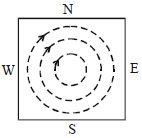
A metal sheet placed in magnetic field, which changes from zero to maximum. If figure  showns direction of eddy currents then direction of magnetic field is
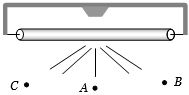
Figure shows a glowing mercury tube. The illuminances at point $A, B$ and $C$ are related as
A potentiometer has uniform potential gradient across it. Two cells connected in series
(i) to support each other and
(ii) to oppose each other are balanced over 6m and 2m respectively on the potentiometer wire.
The e.m.f.’s of the cells are in the ratio of
Three equal charges $+q$ are placed at the three vertices of an equilateral triangle centred at the origin. They are held in equilibrium by a restoring force of magnitude $F(r)=k r$ directed towards the origin, where $k$ is a constant. What is the distance of the three charges from the origin?
A cylindrical conductor has uniform cross-section. Resistivity of its material increase linearly from left end to right end. If a constant current is flowing through it and at a section distance $x$ from left end, magnitude of electric field intensity is $E$, which of the following graphs is correct
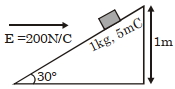
An inclined plane making an angle of $30^{\circ}$ with the horizontal is placed in a uniform horizontal electric field $200 \, \frac{ N }{ C }$ as shown in the figure. A body of mass $1\, kg$ and charge $5\, mC$ is allowed to slide down from rest at a height of $1\, m$. If the coefficient of friction is $0.2,$ find the time (in $s$ )taken by the body to reach the bottom. $\left[ g =9.8 \,m / s ^{2}, \sin 30^{\circ}=\frac{1}{2}\right.$; $\left.\cos 30^{\circ}=\frac{\sqrt{3}}{2}\right]$
In a sensitive Wheatstone bridge, current in the galvanometer in the state of slight deflection from the position of balance is:
In a fission process, nucleus A divides into two nuclei B and C, their binding energies being $E_a,E_b$ and $E_c$ respectively. Then
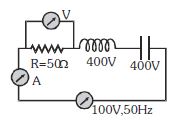
In given $LCR$ circuit, the voltage across the terminals of a resistance and current will be