MCQ
The force constant of a wire does not depend on
  • A
    Nature of the material
  • B
    Radius of the wire
  • C
    Length of the wire
  • None of the above

Answer

Correct option: D.
None of the above
d
(d) $K = \frac{{YA}}{L} = \frac{{Y \times \pi {r^2}}}{L} \Rightarrow K \propto \frac{{Y{r^2}}}{L}$

i.e. force constant of a wire depends on young's modules (nature of the material), radius of the wire and length of the wire.

Need a full question paper?

Generate a complete, print-ready paper with questions like this in minutes — across 16+ boards, with answer keys.
Start Generating Free

Similar questions

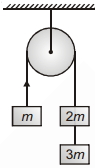
In the figure given below, with what acceleration does the block of mass $m$ will move? (Pulley and strings are massless and frictionless)
A force of 10N is applied on an object of mass 2kg placed on a rough surface having coefficient of friction equal to 0.2. Work done by applied force in 4s is:
A spaceship orbits around a planet at a height of $20\,km$ from its surface. Assuming that only gravitational field of the plant acts on the spaceship. What will be the number of complete revolutions made by the spaceship in $24\,hours$ around the plane? [Given: Mass of plane $= 8 \times 10^{22}\,kg,$ Radius of planet $= 2\times 10^6\,m,$ Gravitational constant $G = 6.67\times 10^{-11}\,Mn^2/kg^2$ ]
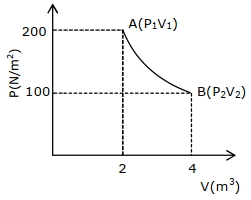
One mole of an ideal gas at $27^{\circ} {C}$ is taken from ${A}$ to ${B}$ as shown in the given ${PV}$ indicator diagram. The work done by the system will be $......\times 10^{-1} \,{J}$

[Given : $R=8.3\, {J} /\,mole\,{K}, \ln 2=0.6931$ ] (Round off to the nearest integer)
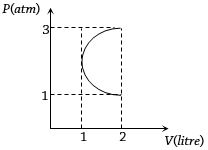
In the $P-V$ diagram shown in figure $ABC$ is a semicircle. The work done in the process $ABC$ is
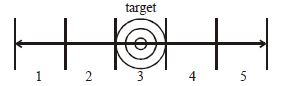
A shooting game involves using a gun that fires by itself at random times. The player can only point the gun in a fixed direction while the target moves from side to side with simple harmonic motion, as shown. At which of the given region should the player aim in order to score the greatest number of hits? 
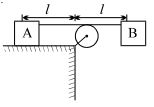
Two blocks $A$ and $B$ each of same mass are attached by a thin inextensible string through an ideal pulley. Initially block $B$ is held in position as shown in fig. Now the block $B$ is released. Block $A$ willl slide to right and hit the pulley in time $t_A$. Block $B$ will swing and hit the surface in time $t_B$.Assume the surface as frictionless. [Hint: Tension $T$ in the string acting on both blocks is same in magnitude. Acceleration needed for horizontal motion is from $T$.
A spring-mass system vibrates such that mass travel on surface of coefficient of friction  $\mu$. Mass is released after compressing the spring by distance a and it travels upto  distance $b$ after its equilibrium position, then travelling from $x = -a$ to $x = b$ the reduction in its amplitude will be :-
Two particles are projected from a tower in opposite directions horizontally with speed $10\,m / s$ each. At $t=1\,s$ match the following two columns.
Column $I$ Column $II$
$(A)$ Relative acceleration between two $(p)$ $0$ SI unit
$(B)$ Relative velocity between two $(q)$ $5$ SI unit
$(C)$ Horizontal distance between two $(r)$ $10$ SI unit
$(D)$ Vertical distance between two $(s)$ $20$ SI unit
A ball of mass $m$ and radius $ r $ is gently released in a viscous liquid. The mass of the liquid displaced by it is $m' $ such that $m > m'$. The terminal velocity is proportional to