Question
The force on a north pole,$\overrightarrow{\text{F}}=\text{m}\overrightarrow{\text{B}},$ is parallel to the field $\overrightarrow{\text{B}}.$ Does it contradict our earlier knowledge that a magnetic field can exert forces only perpendicular to itself?
Answer

Yes it contradicts as force is always perpendicular to magnetic field. but in case other force is very far distant then the magnetic field can be parallel to force.

Need a full question paper?

Generate a complete, print-ready paper with questions like this in minutes — across 16+ boards, with answer keys.

Start Generating Free

Similar questions

  1. Why are infra-red waves often called heat waves? Explain.
  2. What do you understand by the statement, ‘‘Electromagnetic waves transport momentum’’?
What is optically denser and optically rarer medium?
What is reflection of light? Define angle of incidence and angle of reflection.
Answer the following question:
Quarks inside protons and neutrons are thought to carry fractional charges [(+2/3)e ; (–1/3)e]. Why do they not show up in Millikan’s oil-drop experiment?
The decay constant of $\text{ }^{197}_{80}\text{Hg}$ (electron capture to $\text{ }^{197}_{79}\text{Au}$) is $1.8 × 10^{-4}\ S^{-1}$.
  1. What is the half-life?
  2. What is the average-life?
  3. How much time will it take to convert 25% of this isotope of mercury into gold?
How does the conductivity of semiconductors increase with increasing temperature?
Give expression for induced emf in AC generator. Discuss, with fogure, how this emf changes with time during one rotation of coil.
A hydrogen atom in a state having a binding energy of 0.85eV makes transition to a state with excitation energy 10.2eV (a) Identify the quantum numbers n of the upper and the lower energy states involved in the transition. (b) Find the wavelength of the emitted radiation.
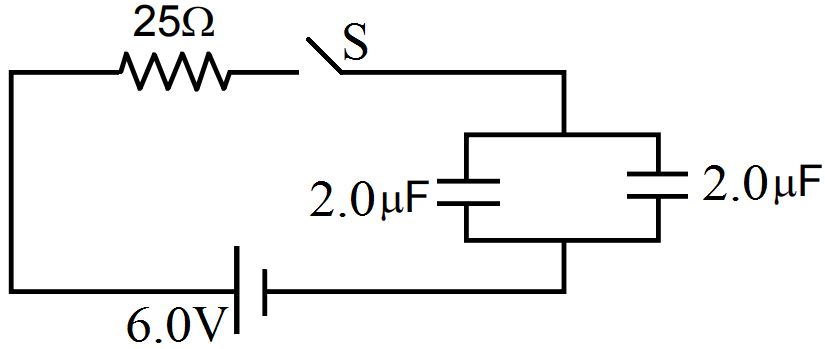
Find the charge on each of the capacitors 0.20ms after the switch S is closed in the figure.
An alternating voltage of frequency f is applied across a series LCR circuit. Let $f_r$  be the resonance frequency for the circuit. Will the current in the circuit lag, lead or remain in phase with the applied voltage when $(i) f > f_r$, $(ii) f < f_r?$ Explain your answer in each case.