Question
The force which a magnet exerts on iron and steel is called the:

Answer

  1. Magnetic force
Explanation:
The force is strongest at the poles of a magnet. Like poles exert a pushing force and repel each other. Unlike poles exert a pulling force and attract each other. magnet A material that attracts steel, iron, cobalt, and nickel.
The force which a magnet exerts on iron and steel is called the magnetic field.

Need a full question paper?

Generate a complete, print-ready paper with questions like this in minutes — across 16+ boards, with answer keys.
Start Generating Free

Similar questions

Which of the following are correct for insulators?
Susceptibility is positive and large for a:
A $1000\Omega$ resistance and a capacitor of $100\Omega$ resistance are connected in series a 220V source. when the capacitor is 50% charged, the value of the displacement current is.
Which one of the following statements is not correct (a) A diode does not obey Ohm's law(b) A PN junction diode symbol shows an arrow identifying the direction of current (forward) flow (c) An ideal diode is an open switch (d) An ideal diode is an ideal one way conductor


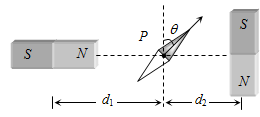
Two magnets $A$ and $B$ are identical and these are arranged as shown in the figure. Their length is negligible in comparison to the separation between them. A magnetic needle is placed between the magnets at point $P$ which gets deflected through an angle $\theta$ under the influence of magnets. The ratio of distance $d_1$  and $d_2$ will be
Out of the following, the one whose frequency is minimum is:
An electron is moving in electric field and magnetic field it will gain energy from(a) Electric field (b) Magnetic field(c) Both of these (d) None of these
       
If heat is supplied to an ideal gas in an isothermal process:
  1. The internal energy of the gas will increase.
  2. The gas will do positive work.
  3. The gas will do negative work.
  4. The said process is not possible.
A thin equiconvex lens is made of glass of refractive index $1.5$ and its focal length is $0.2 m,$ if it acts as a concave lens of $0.5 m$ focal length when dipped in a liquid, the refractive index of the liquid is
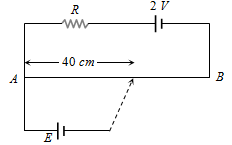
$AB$ is a potentiometer wire of length $100 \ cm$ and its resistance is $10$ ohms. It is connected in series with a resistance $R = 40$ ohms and a battery of $\text{e.m.f.}\ 2 V$ and negligible internal resistance. If a source of unknown $\text{e.m.f.} \ E$ is balanced by $40 \ cm$ length of the potentiometer wire, the value of $E$ is