MCQ
The four points whose co-ordinates are $(2, 1), (1, 4), (4, 5), (5, 2)$ form :
  • A
    a rectangle which is not a square
  • B
    a trapezium which is not a parallelogram
  • a square
  • D
    a rhombus which is not a square.

Answer

Correct option: C.
a square
c
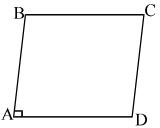
$A(2, 1), B (1, 4), C(4, 5), D(5, 2)$

$AB = BC = CD = DA =\sqrt{10}$

also $AC \bot BD$

i.e. $m_{AC}\, \times\, m_{BD} = -1$

and $AC = BD$
Need a full question paper?

Generate a complete, print-ready paper with questions like this in minutes — across 16+ boards, with answer keys.

Start Generating Free

Similar questions

There are 12 points in a plane. The number of the straight lines joining any two of them when 3 of them are collinear is:
The equation of the circle whose centre is $(3, -1)$ and which cuts off a chord of length $6$ on the line $2x - 5y + 18 = 0$ is
Let $\alpha, \beta$ be the roots of the equation $x^2-\sqrt{6} x+3=0$ such that $\operatorname{Im}(\alpha)>\operatorname{Im}(\beta)$. Let $a, b$ be integers not divisible by $3$ and $n$ be a natural number such that $\frac{\alpha^{99}}{\beta}+\alpha^{98}=3^n(a+i b), i=\sqrt{-1}$. Then $\mathrm{n}+\mathrm{a}+\mathrm{b}$ is equal to_.....................
If the points $(k,\,2 - 2k)$, $(1 - k,{\rm{ }}2k)$ and $( - k - 4,{\rm{ }}6 - 2k)$ be collinear, then the possible values of $ k$ are
If the number of five digit numbers with distinct digits and $2$ at the $10^{\text {th }}$ place is $336 \mathrm{k}$, then $\mathrm{k}$ is equal to
If $F_1$ and $F_2$ be the feet of the perpendicular from the foci $S_1$ and $S_2$ of an ellipse $\frac{{{x^2}}}{5} + \frac{{{y^2}}}{3} = 1$ on the tangent at any point $P$ on the ellipse, then $(S_1 F_1) (S_2 F_2)$ is equal to
On the occasion of Deepawali festival, each student of a class sends greeting cards to the others.If there are 20 students in the class, then the total number of greeting cards exchanged by the students is:
If in the expansion of $\Big(\text{x}^{4}-\frac{1}{\text{x}^{3}}\Big)^{15},\text{x}^{-17}$ occurs in rth term, then
The value of $n \in Z$ for which the function $f(x) = \frac{{\sin nx}}{{\sin (x/n)}}$ has $4\pi $ as its period, is
For every positive integer $n, 7^n-3^n$ is divisible by: