The frequency of a stretched uniform wire under tension is in resonance with the fundamental frequency of a closed tube. If the tension in the wire is increased by $8 N,$ it is in resonance with the first overtone of the closed tube. The initial tension in the wire is .... $N$
Diffcult


Download our appand get started for free
Experience the future of education. Simply download our apps or reach out to us for more information. Let's shape the future of learning together!No signup needed.*
Similar Questions
- 1View SolutionWhen a wave travelling in medium is reflected from the boundary of a denser medium, which of the following will not change?
- 2A wave is travelling along a string. At an instant, shape of the string is as shown in fig. At this instant, point $A$ is moving upwards. Which of the following statements is/are correctView Solution
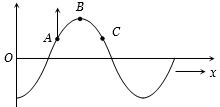
- 3A standing wave in a pipe with a length $L=1.2 \,m$ is described by $y(x, t)=y_0 \sin [(2 \pi / L) x] \sin [(2 \pi / L) x+\pi / 4]$ based on above information, which one of the following statement is incorrect? (Speed of sound in air is $300 \,ms ^{-1}$ )View Solution
- 4You are driving in your car listening to music on the radio. Your car is equipped with radio that can recieved radio singals of frequency $(f_1 \approx\, 3\, MHz),$ other of frequency $(f_2 \approx\, 30\, MHz),$ and third of frequency $(f_3 =\, 3\, GHz),$. You enter a tunnel with a circular opening of diameter $10\ m.$ Which kind of radio signal will you be able to receive the longest as you continue to travel in the tunnel ?View Solution
- 5The relation between time and displacement for two particles is given byView Solution
${y_1} = 0.06\sin 2\pi (1.04t + {\phi _1})$,
${y_2} = 0.03\sin 2\pi (1.04t + {\phi _2})$
The ratio of the intensity of the waves produced by the vibrations of the two particles will be
- 6View SolutionA big explosion on the moon cannot be heard on the earth because
- 7At $23^{\circ} C$, a pipe open at both ends resonates at a frequency of $450 \,Hz$. At what frequency does the same pipe resonate on a hot day when the speed of sound is $4 \%$ higher than it would be at $23^{\circ} C$ ?View Solution
- 8The tension of a stretched string is increased by $69\%$. In order to keep its frequency of vibration constant, its length must be increased by .... $\%$View Solution
- 9View SolutionAs a wave propagates
- 10Two cars moving in opposite directions approach each other with speed of $22\, m s^{-1}$ and $16.5 \, m s^{-1}$ respectively. The driver of the first car blows a horn having a frequency $400 \,Hz.$ The frequency heard by the driver of the second car is ..... $Hz$ (velocity of sound is $340 \, m s^{-1}$)View Solution