Question
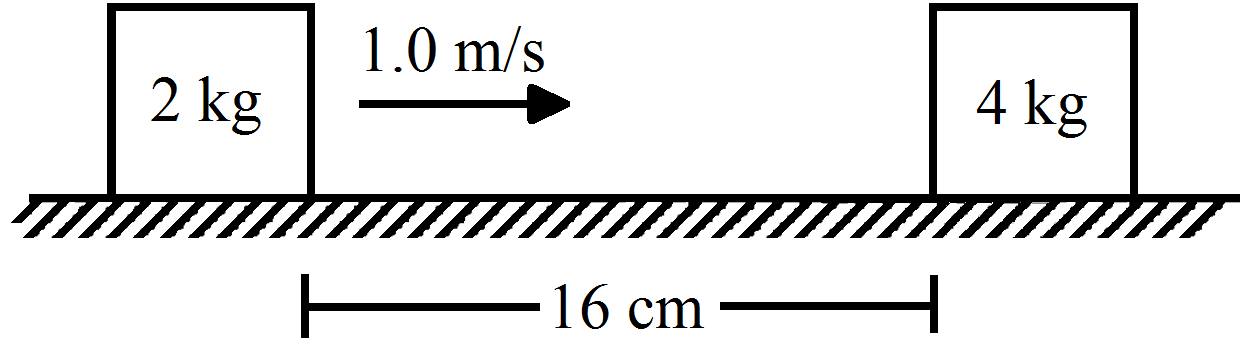
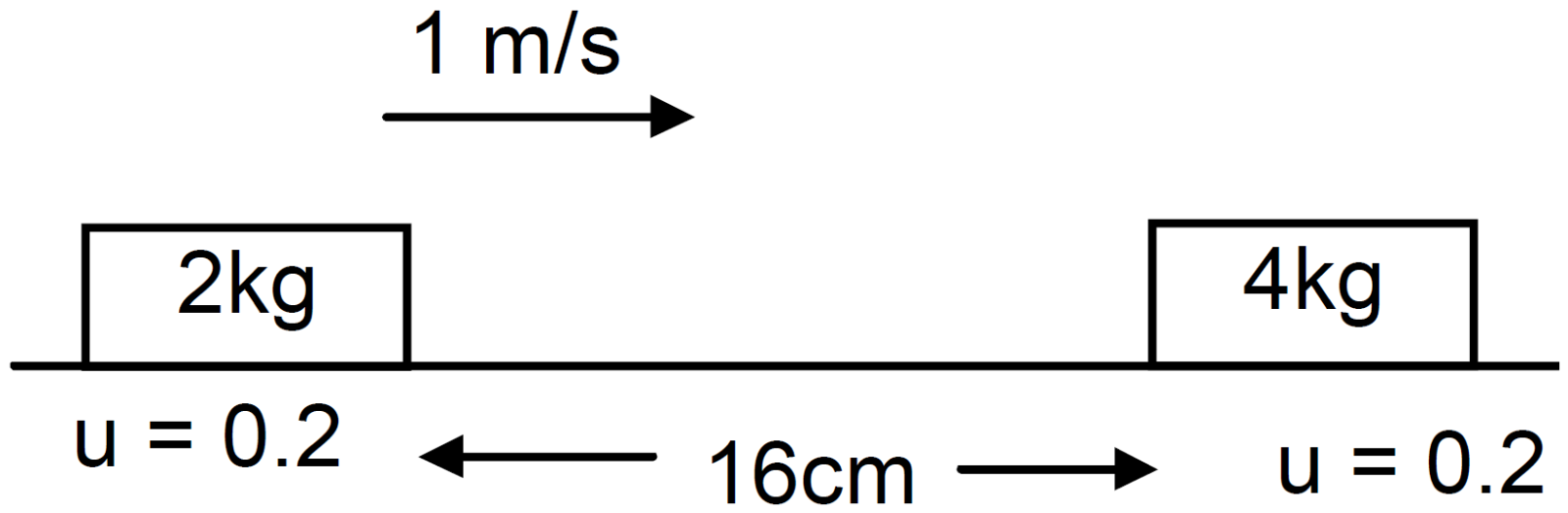
The friction coefficient between the horizontal surface and each of the blocks shown in figure is 0.20. The collision between the blocks is perfectly elastic. Find the separation between the two blocks when they come o rest. Take $g = 10 m/s^2.$​​​​​​​

Answer

Let velocity of 2kg block on reaching the 4kg block before collision $= u_1$. Given, $V_2 = 0$ (velocity of 4kg block). $\therefore$ From work energy principle,
$\Big(\frac{1}{2}\Big)\text{m}\times\text{u}_1^2-\Big(\frac{1}{2}\Big)\text{m}\times1^2=-\text{m}\times\text{ug}\times\text{s}$
$\Rightarrow\frac{\text{u}_1^2-1}{2}=-2\times5$
$\Rightarrow-16=\frac{\text{u}_1^2-1}{4}$
$\Rightarrow64\times10^{-2}=\text{u}_1^2-1$
$\Rightarrow\text{u}_1=6\text{m/s}$
Since it is a perfectly elastic collision.
Let $V_1, V_2 \rightarrow $ velocity of 2kg & 4kg block after collision.
$​​​​​​​m_1V_1 + m_2V_2 = m_1v_1 + m_2v_2$
$\Rightarrow 2 \times 0.6 + 4 \times 0 = 2v_1 + 4v_2$
$\Rightarrow v_1 + 2v_2 = 0.6 ...(1)$
Again, $V_1 - V_2 = -(u_1 - u_2) = -(0.6 - 0) = -0.6 ...(2)$
Subtracting (2) from (1)
$\Rightarrow 3v_2 = 1.2$
$\Rightarrow v_2 = 0.4 m/s.$
$\Rightarrow v_1 = -0.6 + 0.4 = -0.2$ m/s
$\therefore$ Putting work energy principle for $1^{st} $2kg block when come to rest.
$\Big(\frac{1}{2}\Big)\times2\times0^2-\Big(\frac{1}{2}\Big)\times2\times(0.2)^2$
$=-2\times0.2\times10\times\text{s}$
$\Rightarrow\Big(\frac{1}{2}\Big)\times2\times0.2\times0.2$
$=2\times0.2\times10\times\text{s}$
$\Rightarrow\text{S}_1=1\text{cm}$
Putting work energy principle for 4kg block.
$\Rightarrow\Big(\frac{1}{2}\Big)\times4\times0^2-\Big(\frac{1}{2}\Big)\times4\times(0.4)^2$
$=-4\times0.2\times10\times\text{s}$
$=2\times0.4\times0.4\times=4\times0.2\times10\times\text{s}$
$\Rightarrow\text{S}_2=4\text{cm}$
Distance between 2kg & 4kg block $= S_1 + S_2 = 1 + 4 = 5cm.$

Need a full question paper?

Generate a complete, print-ready paper with questions like this in minutes — across 16+ boards, with answer keys.

Start Generating Free

Similar questions

An artificial satellite is revolving around a planet of mass M and radius R, in a circular orbit of radius r. From Kepler’s Third law about the period of a satellite around a common central body, square of the period of revolution T is proportional to the cube of the radius of the orbit r. Show using dimensional analysis, that $\text{T}=\frac{\text{k}}{\text{R}}\sqrt{\frac{\text{r}^3}{\text{g}}},$ where k is a dimensionless constant and g is acceleration due to gravity.
What is the law of conservation of mechanical energy? Explain the conservation of mechanical energy in an elastic spring.
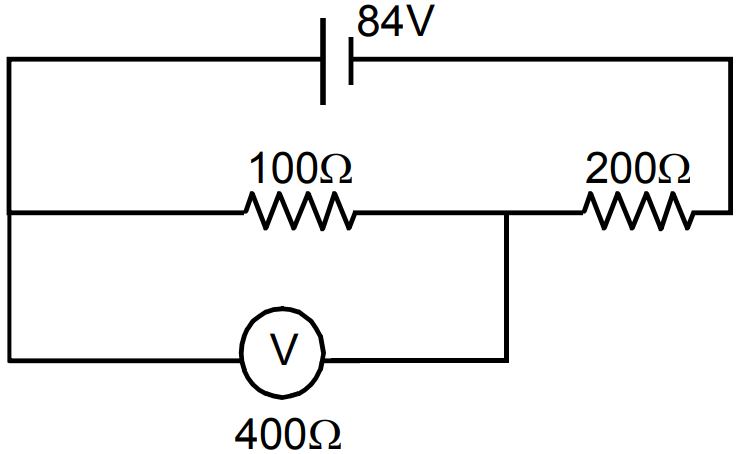
A voltmeter of resistance $400\Omega$ is used to measure the potential difference across the $100\Omega$ resistor in the circuit shown in the figure. (a) What will be the reading of the voltmeter? (b) What was the potential difference across $100\Omega$ before the voltmeter was connected?
A steel rod of length 2l, cross sectional area A and mass M is set rotating in a horizontal plane about an axis passing through the centre. If Y is the Young’s modulus for steel, find the extension in the length of the rod. (Assume the rod is uniform.)
The figure shows an adiabatic cylindrical tube of volume $V_0$ divided in two parts by a frictionless adiabatic separator. Initially, the separator is kept in the middle, an ideal gas at pressure $p_1$ and temperature $T_1$ is injected into the left part and another ideal gas at pressure $p_2$ and temperature $T_2$ is injected into the right part. $\frac{\text{C}_\text{P}}{\text{C}_\text{V}}=\gamma$ is the same for both the gases. The separator is slid slowly and is released at a position where it can stay in equilibrium. Find,
  1. The volumes of the two parts.
  2. The heat given to the gas in the left part.
  3. The final common pressure of the gases.
A uniform spring whose unstretched length is l has a force constant k. The spring is cut into two pieces of unstretched lengths. $l_1$, and $l_2$ where $l_1 = nl_2$, and n is an integer. What are the corresponding force constants $k_1$ and $k_1$ in terms of n and k?
A capacitor of capacitance $10\mu\text{F}$ is connected to a battery of emf 2V. It is found that it takes 50ms for the charge of the capacitor to become $12.6\mu\text{C}.$ Find the resistance of the circuit.
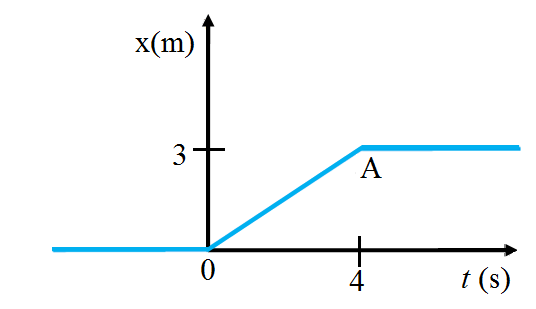
Figure. shows the position-time graph of a particle of mass 4kg. What is the (a) force on the particle for t < 0, t > 4s, 0 < t < 4s? (b) impulse at t = 0 and t = 4s? (Consider one-dimensional motion only).
A convex lens of focal length 20cm and a concave lens of focal length 10cm are placed 10cm apart with their principal axes coinciding. A beam of light travelling parallel to the principal axis and having a beam diameter 5.0mm, is incident on the combination. Show that the emergent beam is parallel to the incident one. Find the beam diameter of the emergent beam.
You are riding in an automobile of mass 3000 kg . Assuming that you are examining the oscillation characteristics of its suspension system. The suspension sags 15 cm when the entire automobile is placed on it. Also, the amplitude of oscillation decreases by $50 \%$ during one complete oscillation. Estimate the values of
a. the spring constant $k$ and
b. the damping constant b for the spring and shock absorber system of one wheel, assuming that each wheel supports 750 kg .