MCQ
The fringe width in Young's double-slit experiment can be increased if we decrease
  • Separation of the slits
  • B
    Distance between the source and the screen
  • C
    Wavelength of the source
  • D
    All of these

Answer

Correct option: A.
Separation of the slits
a
(a)

Fringe width $(\beta)=\frac{\lambda D}{d}$

Hence if we decrease $d\left(\beta \propto \frac{1}{d}\right)$

$\beta$ is increased.

Need a full question paper?

Generate a complete, print-ready paper with questions like this in minutes — across 16+ boards, with answer keys.
Start Generating Free

Similar questions

The electric field between the two spheres of a charged spherical condenser
A circular loop ofradius $0.3\ cm$ lies parallel to amuch bigger circular loop ofradius $20\ cm$. The centre of the small loop is on the axis of the bigger loop. The distance between their centres is $15\ cm$. If a current of $2.0\ A$ flows through the smaller loop, then the flux linked with bigger loop is
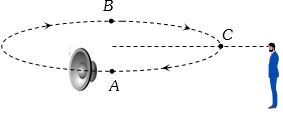
A small source of sound moves on a circle as shown in the figure and an observer is standing on $O$. Let ${n_1},\;{n_2}$ and ${n_3}$be the frequencies heard when the source is at $A,\,B$ and $C$ respectively. Then
The two light beams having intensities I and 9I interfere to produce a fringe pattern on a screen. The phase difference between the beams is $\frac{\pi}{2}$ at point $P$ and $\pi$ at point $Q$. Then the difference between the resultant intensities at $P$ and $Q$ will be.......$I$
$A$ concave mirror is placed on a horizontal surface and two thin uniform layers of different transparent liquids (which do not mix or interact) are formed on the reflecting surface. The refractive indices of the upper and lower liquids are $\mu_1$ and $\mu_2$ respectively. The bright point source at a height $‘d’$ ($d$ is very large in comparison to the thickness of the film) above the mirror coincides with its own final image. The radius of curvature of the reflecting surface therefore is
If velocity $v$, acceleration $A$ and force $F$ are chosen as fundamental quantities, then the dimensional formula of angular momentum in terms of $v,\,A$ and $F$ would be
A body is moving from rest under constant acceleration and let ${S_1}$ be the displacement in the first $(p - 1)$ sec and ${S_2}$ be the displacement in the first $p\,\sec .$ The displacement in ${({p^2} - p + 1)^{th}}$ sec. will be
The main drawback of huygen's theory was
Four identical particles of mass $m$ are kept at the four corners of a square. If the gravitational force exerted on one of the masses by the other masses is $\left(\frac{2 \sqrt{2}+1}{32}\right) \frac{\mathrm{Gm}^2}{\mathrm{~L}^2}$, the length of the sides of the square is
A scalar quantity is one that