Question
The function f : A → B defined by f(x) = -x2 + 6x- 8 is a bijection if,
  1. $\text{A}=(-\infty,3]$ and $\text{B}=(-\infty,1]$
  2. $\text{A}=[-3,\infty)$ and $\text{B}=(-\infty,1]$
  3. $\text{A}=(-\infty,3]$ and $\text{B}=[1,\infty)$
  4. $\text{A}=[3,\infty)$ and $\text{B}=[1,\infty)$
Answer

  1. $\text{A}=(-\infty,3]$ and $\text{B}=(-\infty,1]$

Solution:

f(x) = -x2 + 6x - 8, is a polynomial function and the domain of polynomial function is real number.

$\therefore\ \text{x}\in\text{R}$

f(x) = -x2 + 6x - 8

= -(x2 - 6x + 8)

= -(x2 - 6x + 9 - 1)

= -(x - 3)2 + 1

Maximum value of -(x - 3)2 woud be 0

$\therefore$ Maximum value of -(x - 3)2 + 1 woud be 1

$\therefore\ \text{f(x)}\in(-\infty,1]$

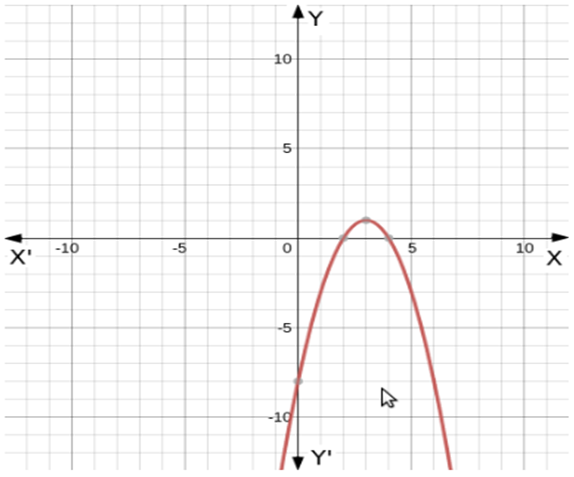
We can see from the given graph that function is symmetrical about x = 3 and the given function is bijective.

So, x would be either $(-\infty,3]\text{ or }[3,\infty)$

The correct option which satisfy A and B both is:

$\text{A}=(-\infty,3]$ and $\text{B}=(-\infty,1]$

Need a full question paper?

Generate a complete, print-ready paper with questions like this in minutes — across 16+ boards, with answer keys.

Start Generating Free

Similar questions

Let $\alpha \beta \neq 0$ and $A=\left[\begin{array}{ccc}\beta & \alpha & 3 \\ \alpha & \alpha & \beta \\ -\beta & \alpha & 2 \alpha\end{array}\right]$. If $B=\left[\begin{array}{ccc}3 \alpha & -9 & 3 \alpha \\ -\alpha & 7 & -2 \alpha \\ -2 \alpha & 5 & -2 \beta\end{array}\right]$ is the matrix of cofactors of the elements of $A$, then $\operatorname{det}(A B)$ is equal to.
What will be the volume of that parallelopiped whose sides are  $ a = i -j + k, b = i -3j + 4k $ and $c = 2i -5j + 3k$ ................ $\mathrm{unit}$
If $f(x) = \int\limits_0^x {\frac{1}{{\sqrt {1 + {t^3}} }}\,} dt$ and $h(x)$ is the inverse of $f(x)$ , then the value of $\frac{{h''(x)}}{{{h^2}(x)}}$ is
The value of $\lambda $ for which the vectors $2\lambda i + j - k$ and $2j + k$ are perpendicular, is
A vector parallel to the line of intersection of the plance $\vec{\text{r}}.(3\hat{\text{i}}-\hat{\text{j}}+\hat{\text{k}})=1$ and $\vec{\text{r}}.(\hat{\text{i}}-4\hat{\text{j}}+2\hat{\text{k}})=2$ is:
  1. $-2\hat{\text{i}}+7\hat{\text{j}}+13\hat{\text{k}}$
  2. $2\hat{\text{i}}+7\hat{\text{j}}-13\hat{\text{k}}$
  3. $-2\hat{\text{i}}-7\hat{\text{j}}+13\hat{\text{k}}$
  4. $2\hat{\text{i}}+7\hat{\text{j}}+13\hat{\text{k}}$
Two vectors each of magnitudes 1 unit are inclined at 60 to each other.The difference of the vectors has a magnitude ________________?
  1. 0 units
  2. 1 units
  3. 2 units
  4. 3 units
Box $I$ contains $30$ cards numbered $1$ to $30$ and Box $II$ contains $20$ cards numbered $31$ to $50 .$ A box is selected at random and a card is drawn from it. The number on the card is found to be a non-prime number. The probability that the card was drawn from Box $I$ is
At what point the slope of the tangent to the curve x2 + y2 - 2x - 3 = 0 is zero:
  1. (3, 0), (-1, 0)
  2. (3, 0), (1, 2)
  3. (-1, 0), (1, 2)
  4. (1, 2), (1, -2)
Area of the region enclosed between the curves $x = y^2 - 1$ and $x = |y| \sqrt {1\, - \,{y^2}} $ is
The solution of the differential equation $(\sin x + \cos x)dy + (\cos x - \sin x)dx = 0$ is