Question
The function f : A → B defined by f(x) = -x2 + 6x- 8 is a bijection if,
  1. $\text{A}=(-\infty,3]$ and $\text{B}=(-\infty,1]$
  2. $\text{A}=[-3,\infty)$ and $\text{B}=(-\infty,1]$
  3. $\text{A}=(-\infty,3]$ and $\text{B}=[1,\infty)$
  4. $\text{A}=[3,\infty)$ and $\text{B}=[1,\infty)$
Answer

  1. $\text{A}=(-\infty,3]$ and $\text{B}=(-\infty,1]$

Solution:

f(x) = -x2 + 6x - 8, is a polynomial function and the domain of polynomial function is real number.

$\therefore\ \text{x}\in\text{R}$

f(x) = -x2 + 6x - 8

= -(x2 - 6x + 8)

= -(x2 - 6x + 9 - 1)

= -(x - 3)2 + 1

Maximum value of -(x - 3)2 woud be 0

$\therefore$ Maximum value of -(x - 3)2 + 1 woud be 1

$\therefore\ \text{f(x)}\in(-\infty,1]$

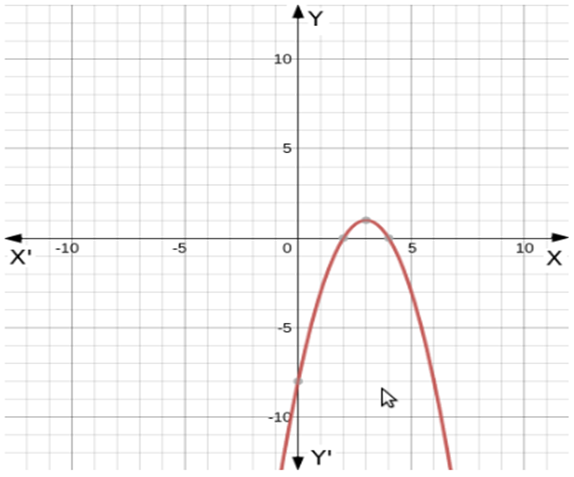
We can see from the given graph that function is symmetrical about x = 3 and the given function is bijective.

So, x would be either $(-\infty,3]\text{ or }[3,\infty)$

The correct option which satisfy A and B both is:

$\text{A}=(-\infty,3]$ and $\text{B}=(-\infty,1]$

Need a full question paper?

Generate a complete, print-ready paper with questions like this in minutes — across 16+ boards, with answer keys.

Start Generating Free

Similar questions

If $f(x) = 3x + 10$, $g(x) = {x^2} - 1$, then ${(fog)^{ - 1}}$ is equal to
If matrix $A$ and $B$ has order respectively $m \times n$ and $n \times p$ then order of AB is :
The range of $a \in R$ for which the function $ f(x)=(4 a-3)\left(x+\log _{e} 5\right)+2(a-7) \cot \left(\frac{x}{2}\right) \sin ^{2}\left(\frac{x}{2}\right)$ $x \neq 2 n \pi, n \in N ,$ has critical points, is
The equation of the line passing through the points $\text{a}_1\hat{\text{i}}+\text{a}_2\hat{\text{j}}+\text{a}_3\hat{\text{k}}$ and $\text{b}\hat{\text{i}}+\text{b}_2\hat{\text{j}}+\text{b}_3\hat{\text{k}}$ is:
  1. $\vec{\text{r}}=\big(\text{a}_1\hat{\text{i}}+\text{a}_2\hat{\text{j}}+\text{a}_3\hat{\text{k}}\big)+\lambda\big(\text{b}_1\hat{\text{i}}+\text{b}_2\hat{\text{j}}+\text{b}_3\hat{\text{k}}\big)$
  2. $\vec{\text{r}}=\big(\text{a}_1\hat{\text{i}}+\text{a}_2\hat{\text{j}}+\text{a}_3\hat{\text{k}}\big)-\text{t}\big(\text{b}_1\hat{\text{i}}+\text{b}_2\hat{\text{j}}+\text{b}_3\hat{\text{k}}\big)$
  3. $\vec{\text{r}}=\text{a}_1(1-\text{t})\hat{\text{i}}+\text{a}_2(1-\text{t})\hat{\text{j}}+\text{a}_3(1-\text{t})\hat{\text{k}}+\text{t}\big(\text{b}_1\hat{\text{i}}+\text{b}_2\hat{\text{j}}+\text{b}_3\hat{\text{k}}\big)$
  4. $\text{None of these}$
The vector equation r = i − 2j − k + t(6j − k) represents a straight line passing through the points:
  1. (0, 6, −1) and (1, −2, −1)
  2. (0, 6, −1) and (−1, −4, −2)
  3. (1, −2, −1) and (1, 4, −2)
  4. (1, −2, −1) and (0, −6, 1)
If $A$ is an invertible matrix of order $2,$ then ${{{\rm{A}}^{ - 1}}}$ is equal to
If a matrix is of order 2 × 3, then the number of elements in the matrix is:
  1. 5
  2. 6
  3. 2
  4. 3
${d \over {dx}}\left[ {\left( {{{{{\tan }^2}2x - {{\tan }^2}x} \over {1 - {{\tan }^2}2x{{\tan }^2}x}}} \right)\cot 3x} \right] =$
If $\text{A}=\frac{1}{3}\begin{bmatrix} 1 & 1 & 2 \\ 2 & 1 & -2 \\ \text{x} & 2 & \text{y} \end{bmatrix}$ is prthogonal, than x + y =
  1. 3
  2. 0
  3. -3
  4. 1
The value of the determinant $\begin{vmatrix} 5 &\text{amp; } 1 \\ 3 &\text{amp; } 2 \end{vmatrix}$
  1. 4
  2. 5
  3. 6
  4. 7