MCQ
The function $f : A \rightarrow B$ defined by $f(x) = -x^2 + 6x- 8$ is a bijection if,
  • $\text{A}=(-\infty,3]$ and $\text{B}=(-\infty,1]$
  • B
    $\text{A}=[-3,\infty)$ and $\text{B}=(-\infty,1]$
  • C
    $\text{A}=(-\infty,3]$ and $\text{B}=[1,\infty)$
  • D
    $\text{A}=[3,\infty)$ and $\text{B}=[1,\infty)$
Answer

Correct option: A.
$\text{A}=(-\infty,3]$ and $\text{B}=(-\infty,1]$
$f(x) = -x^2 + 6x - 8,$ is a polynomial function and the domain of polynomial function is real number.
$\therefore\ \text{x}\in\text{R}$
$f(x) = -x^2 + 6x - 8$
$= -(x^2 - 6x + 8)$
$= -(x^2 - 6x + 9 - 1)$
$= -(x - 3)^2 + 1$
Maximum value of $-(x - 3)^2$ woud be $0$
$\therefore$ Maximum value of $-(x - 3)^2 + 1$ woud be $1$
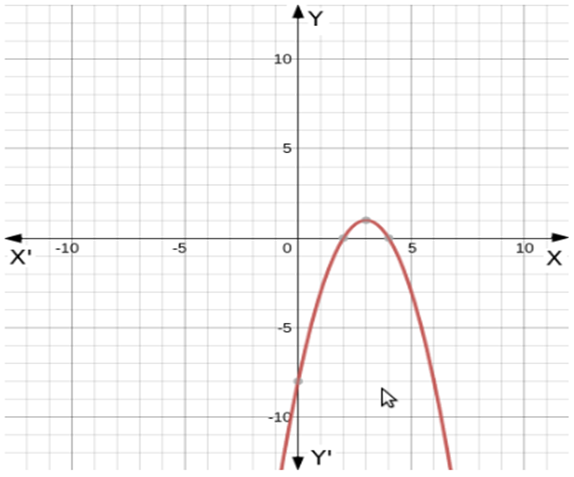
$\therefore\ \text{f(x)}\in(-\infty,1]$

We can see from the given graph that function is symmetrical about $x = 3$ and the given function is bijective.
So, $x$ would be either $(-\infty,3]\text{ or }[3,\infty)$
The correct option which satisfy $A$ and $B$ both is:
$\text{A}=(-\infty,3]$ and $\text{B}=(-\infty,1]$

Need a full question paper?

Generate a complete, print-ready paper with questions like this in minutes — across 16+ boards, with answer keys.

Start Generating Free

Similar questions

The interval for which ${\sin ^{ - 1}}\sqrt x + {\cos ^{ - 1}}\sqrt x = \frac{\pi }{2}$ holds
The value of the definite integral $\int\limits_2^3 {\,\,\left[ {\sqrt {2x - \sqrt {5(4x - 5)} }  + \sqrt {2x + \sqrt {5(4x - 5)} } } \right]} \,dx$ $=$
What is the value of $\int\limits_{-1}^{1} \sin^3\text{x}\cos^2\text{x  dx} :$
If $a, b, c$ are unit vectors such that $a + b + c = 0,$ then the value of $a.b + b.c + c.a$ is:
If $\cos^{-1}\text{x}>\sin^{-1}\text{x},$ then:
If matrix $\text{A}=\big[\text{a}_{\text{ij}}\big]_{2\times2'}$ where $\text{a}_\text{ij}=\begin{cases}1,&\text{if }\text{i }\neq\text{j}\\0,&\text{if }\text{i }=\text{j}\end{cases},$ then $A^2$ is equal to:
Directions: In the following questions, the Assertions (A) and Reason(s) (R) have been put forward. Read both the statements carefully and choose the correct alternative from the following:
Assertion (A): Assertion (A):For an objective function Z= 15x + 20y, corner points are (0, 0), (10, 0), (0, 15) and (5, 5). Then optimal values are 300 and 0 respectively.
Reason (R): The maximum or minimum value of an objective function is known as optimal value of LPP. These values are obtained at corner points.
If $A$ satisfies the equation $\text{x}^2-5\text{x}^2+4\text{x}+\lambda=0$ then $A^{-1}$ exists if:
Five fair coins are tossed simultaneously. The probability of the events that atleast one head comes up is
If $f(x)=x^3+b x^2+c x+d$ and $0 < b^2 < c$ then in the interval $(-\infty, \infty) , f(x)$ is