Question
The function f is defined by $\text{f(x)}=\begin{cases}1-\text{x},&\text{x}<0\\1,&\text{x}=0\\\text{x}+1,&\text{x>0}\end{cases}$ Draw the graph of f(x).
Answer

Let,

$\text{f(x)}=\begin{cases}1-\text{x},&\text{x}<0\\1,&\text{x}=0\\\text{x}+1,&\text{x>0}\end{cases}$

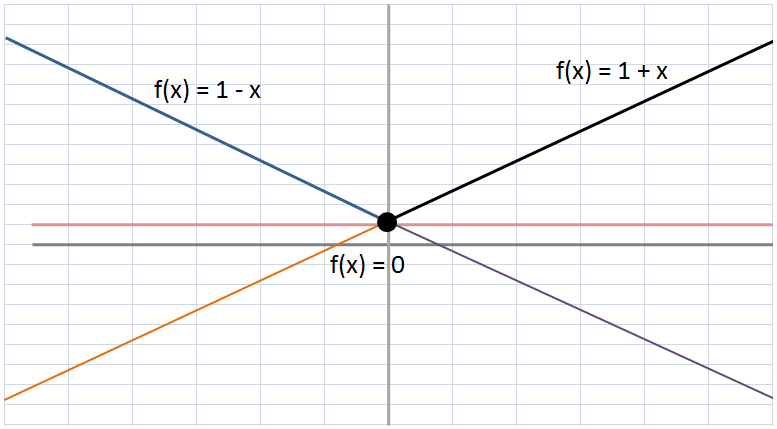
The graph of f(x) for x < 0 is the part of the line y = 1 - x that lies to the left of origin.

The graph of f(x) for x > 0 is the part of the line y = 1 + x that lies to the right of origin.

For x = 0, the graph of f(x) represents the point (0, 1)

The graph of f(x) is shown below.

Need a full question paper?

Generate a complete, print-ready paper with questions like this in minutes — across 16+ boards, with answer keys.

Start Generating Free

Similar questions

Differentiate the functions with respect to 'x'.
$\text{x}^{\frac{2}{3}}$
Evaluate the following limit:
$\lim\limits_{\text{x}\rightarrow0}\frac{\cos2\text{x}-1}{\cos\text{x}-1}$
An experiment involves rolling a pair of dice and recording the numbers that come up. Describe the following events:
A: the sum is greater than 8, B: 2 occurs on either die.
C: the sum is at least 7 and a multiple of 3
which pairs of these events are mutually exclusive?
Evaluate the following:
$\text{x}^4-4\text{x}^3+4\text{x}^2+8\text{x}+44,$ when $\text{x}=3+2\text{i}$
Differentiate the following from the first principle

$\text{x}\cos\text{x}$

If the A.M. of two positive numbers a and b (a > b) is twice their geometric mean. Prove that: $\text{a} : \text{b} = \big(2 +\sqrt{3}\big):\big(2-\sqrt{3}\big).$
If $\text{a}\cos2\theta+\text{b}\sin2\theta=\text{c}$ has $\alpha$ and $\beta$ as its roots, then prove that $\tan\alpha+\tan\beta=\frac{2\text{b}}{\text{a+b}}.$
[Hint: Use the identities $\cos2\theta=\frac{1-\tan^2\theta}{1+\tan^2\theta}$ and $\sin2\theta=\frac{2\tan\theta}{1+\tan^2\theta}\Big].$
Prove the following by the principle of mathematical induction:
$1.2 + 2.3 + 3.4 + ... +\text{n}(\text{n}+1)=\frac{\text{n}(\text{n}+1)(\text{n}+2)}{3}$
Find the eccentricity, coordinates of the foci, equation of the directrices and lenght of the latus-rectum of the hyperbola
$9\text{x}^{2}-16\text{y}^{2}=144$
Evaluate the following limit:
$\lim\limits_{\text{x}\rightarrow{{\pi}}}\frac{\sqrt{2+\cos\text{x}-1}}{(\pi-\text{x})^2}$