Question
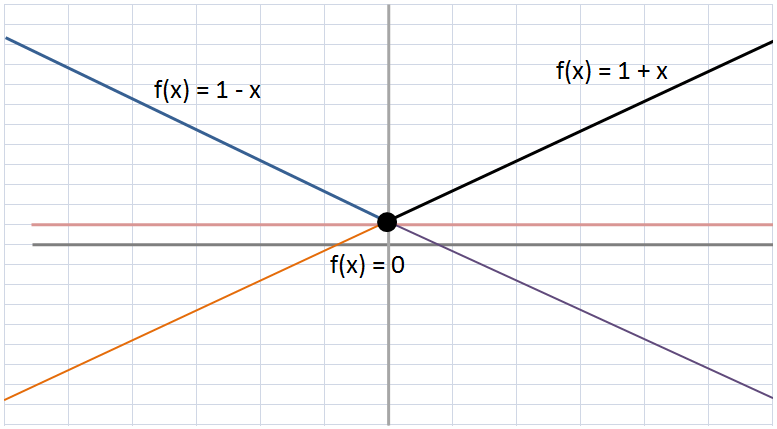
The function f is defined by $\text{f(x)}=\begin{cases}1-\text{x},&\text{x}<0\\1,&\text{x}=0\\\text{x}+1,&\text{x>0}\end{cases}$ Draw the graph of f(x).
Answer

Let, $\text{f(x)}=\begin{cases}1-\text{x},&\text{x}<0\\1,&\text{x}=0\\\text{x}+1,&\text{x>0}\end{cases}$ The graph of f(x) for x < 0 is the part of the line y = 1 - x that lies to the left of origin. The graph of f(x) for x > 0 is the part of the line y = 1 + x that lies to the right of origin. For x = 0, the graph of f(x) represents the point (0, 1) The graph of f(x) is shown below.

Need a full question paper?

Generate a complete, print-ready paper with questions like this in minutes — across 16+ boards, with answer keys.

Start Generating Free

Similar questions

Prove the following by using the principle of mathematical induction for all n ∈ N:
$3^{2\text{n}+2}-8\text{n}-9$ is divisible by 8.
Use the Principle of Mathematical Induction in the following Exercis.
Prove that: $\cos\theta \cdot\cos2\theta\cdot\cos2^2\theta\ ....\text{ cos}2^{\text{n}-1}\theta=\frac{\sin2^{\text{n}}\theta}{2^{\text{n}}\sin\theta},\forall\text{ n}\in\text{N}$ 
Find the area of the triangle formed by the lines $y - x = 0, x + y = 0$ and $x - k = 0.$
$\text{a}\sin\frac{\text{A}}{2}\sin\Big(\frac{\text{B}-\text{C}}{2}\Big)+\text{b}\sin\frac{\text{B}}{2}\sin\Big(\frac{\text{C}-\text{A}}{2}\Big)+\text{c}\sin\frac{\text{C}}{2}\sin\Big(\frac{\text{A}-\text{B}}{2}\Big)=0.$
How many triangles can be obtained by joining 12 points, five of which are collinear?
The mean and standard deviation of $100$ observation were calculated as $40$ and $5.1$ respectively by a student who took by mistake $50$ instead of $40$ for one observation. What are the correct mean and standard deviation?
The weight of coffee in $70$ jars is shown in the following table:
Weight (in grams): $200-201 $201-202 $202-203 $203-204 $204-205 $205-206
Frequency: $13$ $27$ $18$ $10$ $1$ $1$
Determine the variance and standard deviation of the above distribution.
Find the value of the expression $\cos^4\frac{\pi}{8}+\cos^4\frac{3\pi}{8}+\cos^4\frac{5\pi}{8}+\cos^4\frac{7\pi}{8}$
[Hint: Simplify the expression to $2\Big(\cos^4\frac{\pi}{8}+\cos^4\frac{3\pi}{8}\Big)=2\Big[\Big(\cos^2\frac{\pi}{8}+\cos^2\frac{3\pi}8{}\Big)^2-2\cos^2\frac{\pi}{8}\cos^2\frac{3\pi}{8}\Big]$
If $2\tan\frac{\alpha}{2}=\tan\frac{\beta}{2},$ prove that $\cos\alpha=\frac{3+5\cos\beta}{5+3\cos\beta}$
Show that the points (0, 7, 10), (-1, 6, 6) and (-4, 9, 6) are the vertices of an isosceles right-angled triangle.