MCQ
The function $f : R \rightarrow R$ defined by $f(x) = 6^x + 6^{|x|}$ is$:$
  • A
    One$-$one and onto.
  • B
    Many one and onto.
  • C
    One$-$one and into.
  • Many one and into.

Answer

Correct option: D.
Many one and into.
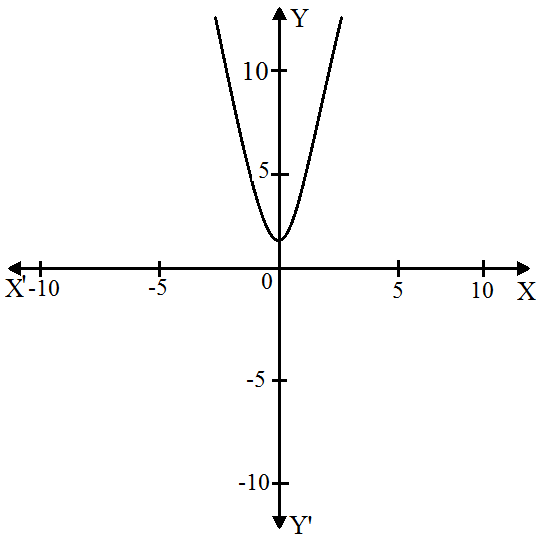
Graph of the given function is as follows$:$

A line parallel to $X-$axis is cutting the graph at two different values.
Therefore, for two different values of $x$ we are getting the same value of $y.$
That means it is many one function.
From the given graph we can see that the range is $[2,\infty)$ and $R$ is the co$-$domain of the given function.
Hence, Co$-$dornain $=$ Range
Therefore, the given function is into.

Need a full question paper?

Generate a complete, print-ready paper with questions like this in minutes — across 16+ boards, with answer keys.

Start Generating Free

Similar questions

If a relation $R$ on the set $\{1,2,3\}$ be defined by $R=\{(1,2)\}$, then $R$ is
Let $A$ be a $3 \times 3$ matrix such that $|\operatorname{adj} A|=64$. Then $|A|$ is equal to:
If the matrix A is both symmetric and skew symmetric, then:
  1. A is a diagonal matrix.
  2. A is a zero matrix.
  3. A is a square matrix.
  4. None of these.
The maximum value of the object function Z = 5x + 10y subject to the constraints $\text{x}+2\text{y}\leq120,\text{x}+\text{y}\geq60,\text{x}-2\text{y}\geq0,\text{x}\geq0,\text{y}\geq0$ is:
If the lines $\text{ x - }\frac{2}{1} =\text{y}-\frac{2}{1} =\text{z}-\frac{4}{\text{k}} $ and $\text{x}-\frac{1}{\text{k}} = \text{y}-\frac{4}{2} = \text{z}-\frac{5}{1} $ are coplanar, then k can have:
  1. Exactly two values
  2. Exactly three values
  3. Exactly one value
  4. Any value
Let $\text{A}=\begin{vmatrix}1&\sin\theta&1\\-\sin\theta&1&\sin\theta\\-1&-\sin\theta&1\end{vmatrix},$ where $0\leq\theta\leq2\pi.$ Then:
If A and B are square matrices such that AB = I and BA = I, then B is:
  1. Unit matrix
  2. Null matrix
  3. Multiplicative inverse matrix of A
  4. -A
The number of different possible orders of matrices having 18 identical elements is:
  1. 3
  2. 1
  3. 6
  4. 4
The differential equation of all parabolas whose axes are parallel to y-axis is:
  1. $\frac{\text{dy}}{\text{dx}}=-\frac{\text{c}^2}{\text{x}^2}$
  2. $\frac{\text{d}^2\text{x}}{\text{dy}^2}=\text{c}$
  3. $\frac{\text{d}^3\text{y}}{\text{dx}^3}+\frac{\text{d}^2\text{x}}{\text{dy}^2}=0$
  4. $\frac{\text{d}^2\text{y}}{\text{dx}^2}+2\frac{\text{dy}}{\text{dx}}=0$
If $\vec{\text{a}}=2\hat{\text{i}}-3\hat{\text{j}}+5\hat{\text{k}},\vec{\text{b}}=3\hat{\text{i}}-4\hat{\text{j}}+5\hat{\text{k}}$ and $\vec{\text{c}}=5\hat{\text{i}}-3\hat{\text{j}}-2\hat{\text{k}},$ then the volume of the parallelopiped with contermious edges $\vec{\text{a}}+\vec{\text{b}},\vec{\text{b}}+\vec{\text{c}},\vec{\text{c}}+\vec{\text{a}}$ is:
  1. 2
  2. 1
  3. -1
  4. 0