MCQ
The function, $f (x) = [|x|] -|[x]|$ where $[ x ]$ denotes greatest integer function
  • A
    is continuous for all positive integers
  • B
    is discontinuous for all non positive integers
  • C
    has finite number of elements in its range
  • All of the above

Answer

Correct option: D.
All of the above
d
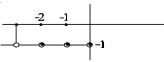
$[ | x | ] - | [x] | =$ $\left[ \begin{gathered}  0\,\,\,\,\,\,\,\,\,\,\,\,\,\,\,\,\,\,\,\,\,\,\,\,x\, = \,1 \hfill \\    - 1\,\,\,\,\,\,\,\,\,\, - 1 < x < 0 \hfill \\  0\,\,\,\,\,\,\,\,\,\,\,\,\,\,\,\,\,0 \leqslant x \leqslant 1 \hfill \\   0\,\,\,\,\,\,\,\,\,\,\,\,\,\,\,\,\,1 < x \leqslant 2 \hfill \\ \end{gathered}  \right.$

$\Rightarrow$  range is $\{0, -1\}$ The graph is 
Need a full question paper?

Generate a complete, print-ready paper with questions like this in minutes — across 16+ boards, with answer keys.

Start Generating Free

Similar questions

If ${a^2},\;{b^2},\;{c^2}$ are in $A.P.$, then ${(b + c)^{ - 1}},\;{(c + a)^{ - 1}}$ and ${(a + b)^{ - 1}}$ will be in
Let

$\alpha=\sum_{ k =1}^{\infty} \sin ^{2 k}\left(\frac{\pi}{6}\right)$

Let $g:[0,1] \rightarrow R$ be the function defined by

$g( x )=2^{\alpha x }+2^{\alpha(1- x )}$

Then, which of the following statements is/are $TRUE$?

$(A)$ The minimum value of $g( x )$ is $2^{\frac{7}{6}}$

$(B)$ The maximum value of $g( x )$ is $1+2^{\frac{1}{3}}$

$(C)$ The function $g( x )$ attains its maximum at more than one point

$(D)$ The function $g( x )$ attains its minimum at more than one point

The vertices of the base of an isosceles triangle lie on a parabola $y^2=4 x$ and the base is a part of the line $y=2 x-4$. If the third vertex of the triangle lies on the $X$-axis, its coordinates are
If $m$ arithmetic means $( A . Ms )$ and three geometric means $(G.Ms)$ are inserted between $3$ and $243$ such that $4^{\text {th }}$ $A.M.$ is equal to $2^{\text {nd }}$ $G.M.$, then $m$ is equal to
The co-ordinates of the vertices $P, Q, R\,\, \& \,\,S$ of square $PQRS$ inscribed in the triangle $ABC$ with vertices $A \equiv (0, 0) , B \equiv (3, 0)\,\, \& \,\,C \equiv (2, 1)$ given that two of its vertices $P, Q$ are on the side $AB$ are respectively
If a chord, which is not a tangent, of the parabola $y^2=16 x$ has the equation $2 x+y=p$, and midpoint $(h, k)$, then which of the following is(are) possible value(s) of $p, h$ and $k$ ?
${d \over {dx}}\left[ {{2 \over \pi }\sin {x^0}} \right] = $
A pair of tangents are drawn from the origin to the circle ${x^2} + {y^2} + 20(x + y) + 20 = 0$. The equation of the pair of tangents is
$\int \limits_{6}^{16} \frac{\log _{\mathrm{e}} x^{2}}{\log _{e} x^{2}+\log _{e}\left(x^{2}-44 x+484\right)} d x$ is equal to:
A function $f,$ defined for all positive real numbers, satisfies the equation $f(x^2) = x^3$ for every $x > 0$ . Then the value of $f ‘ (4) =$