MCQ
The function $f:[0,3] \rightarrow[1,29]$, defined by $f(x)=2 x^3-15 x^2+36 x+1$, is
  • A
    one-one and onto
  • onto but not one-one
  • C
    one-one but not onto
  • D
    neither one-one nor onto

Answer

Correct option: B.
onto but not one-one
b
$F:[0,3] \rightarrow[1,29] $

$f(x)=2 x^3-15 x^2+36 x+1 $

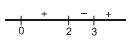
$f^{\prime}(x)=6 x^2-30 x+36 $

$=6\left(x^2-5 x+6\right) $

$=6(x-2)(x-3)$

in given domain function has local maxima, it is many-one

Now at

$x=0 $$ f(0) $$ =1 $

$x=2 $$ f(2) $$ =16-60+72+1=29 $

$x $$ =3 $$ f(3) $$ =54-135+108+1 $

$ =163-135=28$

Has range $=[1,29]$

Hence given function is onto
Need a full question paper?

Generate a complete, print-ready paper with questions like this in minutes — across 16+ boards, with answer keys.

Start Generating Free

Similar questions

Let a function $f: R \rightarrow R$ be defined as :
$f(x)=\left\{\begin{array}{ll} \int_{0}^{x}(5-|t-3|) d t, & x>4 \\ x^{2}+b x & , x \leq 4
\end{array}\right.$ 
where $b \in R$. If $f$ is continuous at $x=4$, then which of the following statements is NOT true?
$\int_{}^{} {(1 - {x^2})\log x\;dx = } $
If $\left| {\begin{array}{*{20}{c}}
  {{a^2}}&{{b^2}}&{{c^2}} \\ 
  {{{(a + \lambda )}^2}}&{{{(b + \lambda )}^2}}&{{{(c + \lambda )}^2}} \\ 
  {{{(a - \lambda )}^2}}&{{{(b - \lambda )}^2}}&{{{(c - \lambda )}^2}} 
\end{array}} \right|$ $ = \,k\lambda \,\,\left| {{\mkern 1mu} {\mkern 1mu} \begin{array}{*{20}{c}}
  {{a^2}}&{{b^2}}&{{c^2}} \\
  a&b&c \\
  1&1&1
\end{array}} \right|,\lambda \, \ne \,0$ then $k$ is equal to
The equations in terms of x and y are:
  1. x – y = 50, 2x – y = 550
  2. x – y = 50, 2x + y = 550
  3. x + y = 50, 2x + y = 550
  4. x + y = 50, 2x – y = 550
The value of $\lim _{n \rightarrow \infty}(-\frac{1}{\sqrt{4 n^2-1}}+-\frac{1}{\sqrt{4 n^2-4}}+\ldots  +\frac{1}{\sqrt{4 n^2-n^2}})$ is
If $\frac{d y}{d x}=\frac{x+y}{x}, y(1)=1$, then $y=$
If ${\sin ^{ - 1}}x = \frac{\pi }{5}$ for some $x \in ( - 1,\,1)$, then the value of ${\cos ^{ - 1}}x$ is
A homogeneous dofferential equation of the from $\frac{\text{dx}}{\text{dy}}=\text{h}(\frac{\text{x}}{\text{y}})$ can be solved by making the substitution:
  1. y = vx
  2. v = yx
  3. x = vy
  4. x = v
A particle moves so that $S = 6 + 48t - {t^3}$. The direction of motion reverses after moving a distance of
If $P = \left[ {\begin{array}{*{20}{c}}1&\alpha &3\\1&3&3\\2&4&4\end{array}} \right]$ is the adjoint of  $3×3 $ matrix $A$  and $ |A|=4$  then $\alpha $ is equal to