MCQ
The function $f:[0,3] \rightarrow[1,29]$, defined by $f(x)=2 x^3-15 x^2+36 x+1$, is
  • A
    one-one and onto
  • onto but not one-one
  • C
    one-one but not onto
  • D
    neither one-one nor onto

Answer

Correct option: B.
onto but not one-one
b
$F:[0,3] \rightarrow[1,29] $

$f(x)=2 x^3-15 x^2+36 x+1 $

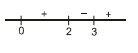
$f^{\prime}(x)=6 x^2-30 x+36 $

$=6\left(x^2-5 x+6\right) $

$=6(x-2)(x-3)$

in given domain function has local maxima, it is many-one

Now at

$x=0 $$ f(0) $$ =1 $

$x=2 $$ f(2) $$ =16-60+72+1=29 $

$x $$ =3 $$ f(3) $$ =54-135+108+1 $

$ =163-135=28$

Has range $=[1,29]$

Hence given function is onto
Need a full question paper?

Generate a complete, print-ready paper with questions like this in minutes — across 16+ boards, with answer keys.

Start Generating Free

Similar questions

Let $A=I_2-2 \mathrm{MM}^{\mathrm{T}}$, where $\mathrm{M}$ is real matrix of order $2 \times 1$ such that the relation $M^T M=I_1$ holds. If $\lambda$ is a real number such that the relation $\mathrm{AX}=\lambda \mathrm{X}$ holds for some non-zero real matrix $X$ of order $2 \times 1$, then the sum of squares of all possible values of $\lambda$ is equal to:
Let $f:\left[ {0,2} \right] \to R$ be a twice differentiable function such that $f''\left( x \right) > 0$, for all $x \in \left( {0,2} \right)$. If $\phi \left( x \right) = f\left( x \right) + f\left( {2 - x} \right)$, then $\phi $ is
In a single throw of two dice what is the probability of obtaining a sum of number greater than $7$, if $4$ appears on the first dice
If $y = {e^{x + {e^{x + {e^{x + ....\infty }}}}}}$, then ${{dy} \over {dx}} = $
Integrating factor of the differential equation $\frac{d y}{d x}+y \tan x-\sec x=0$ is
The first derivative of the function $(\sin 2x\cos 2x\cos 3x + {\log _2}{2^{x + 3}})$ with respect to $ x$  at $x = \pi $ is
$\left| {\,\begin{array}{*{20}{c}}{{a^2}}&{{b^2}}&{{c^2}}\\{{{(a + 1)}^2}}&{{{(b + 1)}^2}}&{{{(c + 1)}^2}}\\{{{(a - 1)}^2}}&{{{(b - 1)}^2}}&{{{(c - 1)}^2}}\end{array}\,} \right| = $
Let $[x]$ denote the greatest integer $\leq x$, where $x \in R$. If the domain of the real valued function $\mathrm{f}(\mathrm{x})=\sqrt{\frac{[\mathrm{x}] \mid-2}{\sqrt{[\mathrm{x}] \mid-3}}}$ is $(-\infty, \mathrm{a}) \cup[\mathrm{b}, \mathrm{c}) \cup[4, \infty), \mathrm{a}\,<\,\mathrm{b}\,<\,\mathrm{c}$, then the value of $\mathrm{a}+\mathrm{b}+\mathrm{c}$ is:
Consider a function $f:R \to R$ 

$f\left( {x + a} \right) = \frac{1}{2} + \sqrt {f\left( x \right) - {f^2}\left( x \right)}$  a is a real constant, then $f(x)$ must be

When the tangent to the curve $\text{y}=\text{x}\log\text{x}$ is parallel to the chord joining the points $(1, 0)$ and $(e, e),$ the value of $x$ is :