MCQ
The function $f(x)=\frac{x^2+2 x-15}{x^2-4 x+9}, x \in R$ is
  • A
     both one-one and onto.
  • B
    onto but not one-one.
  • neither one-one nor onto.
  • D
     one-one but not onto.

Answer

Correct option: C.
neither one-one nor onto.
c
$f(x)=\frac{(x+5)(x-3)}{x^2-4 x+9}$

Let $g(x)=x^2-4 x+9$

$ D < 0 $

$ g(x) > 0$ for $x \in R$

$\therefore\left[\begin{array}{l}\mathrm{f}(-5)=0 \\ \mathrm{f}(3)=0\end{array}\right.$

So, $\mathrm{f}(\mathrm{x})$ is many-one.

again,

$ y x^2-4 x y+9 y=x^2+2 x-15 $

$ x^2(y-1)-2 x(2 y+1)+(9 y+15)=0 $

$ \text { for } \forall x \in R \Rightarrow D \geq 0 $

$ D=4(2 y+1)^2-4(y-1)(9 y+15) \geq 0 $

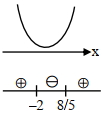
$ 5 y^2+2 y+16 \leq 0 $

$ (5 y-8)(y+2) \leq 0$

$Image$

$\mathrm{y} \in\left[-2, \frac{8}{5}\right]$ range

Note : If function is defined from $f: R \rightarrow R$ then only correct answer is option ($3$)

$\Rightarrow$ Bonus
Need a full question paper?

Generate a complete, print-ready paper with questions like this in minutes — across 16+ boards, with answer keys.

Start Generating Free

Similar questions

If $a = i - 2j$ and $b = 2i + \lambda j$ are parallel, then $\lambda $ is
The sum of the order and the degree of the differential equation $\frac{d}{d x}\left(\frac{d y}{d x}\right)^3$ is
If $f:\left\{ {1,2,3,4} \right\} \to \left\{ {1,2,3,4} \right\}$ and $y=f(x)$ be a function such that $\left| {f\left( \alpha  \right) - \alpha } \right| \leqslant 1$,for $\alpha  \in \left\{ {1,2,3,4} \right\}$ then total number of such functions are
Domain of $\cos ^{-1}[x]$ (where [.] denotes G.I.F.) is
Let $f:\left[ {4,\infty } \right) \to \left[ {1,\infty } \right)$ be a function defined by $f\left( x \right) = {5^{x\left( {x - 4} \right)}}$  then $f^{-1}(x)$  is
If $a = i - 2j + 3k$ and $b = 3i + j + 2k,$ then the unit vector perpendicular to $a$  and  $b$  is
The differential equation of the family of curves represented by the equation ${x^2} + {y^2} = {a^2}$ is
Let A = {1, 2, 3} and consider the relation R = {(1, 1), (2, 2), (3, 3), (1, 2), (2, 3), (1, 3)}. Then, R is:
  1. Reflexive but not symmetric.
  2. Reflexive but not transitive.
  3. Symmetric and transitive.
  4. Neither symmetric nor transitive.
Consider a pair of circles $(|x| -1)^2 + y^2$ = $1$ , Ram is moving away from origin along one circle in clockwise direction at the rate $2\ m/s$ and Shyam is moving away from origin along other circle in anticlockwise direction at the rate $1\ m/s$ . If Ram and Shyam start their journey from origin, then rate of change of distance between Ram and Shyam at the instant when Ram crosses $x-$ axis first time, is
$\mathop {\lim }\limits_{n \to \infty } \frac{{{1^p} + {2^p} + {3^p} + ..... + {n^p}}}{{{n^{p + 1}}}} = $