MCQ
The function $f(x) = x^9+ 3x^7 + 64$ is increasing on:
  • $\text{R}$
  • B
    $(-\infty,0)$
  • C
    $(0,\infty)$
  • D
    $\text{R}_0$

Answer

Correct option: A.
$\text{R}$

$\text{f}(\text{x})=\text{x}^9+3\text{x}^7+64$
$\text{f}'(\text{x})=9\text{x}^8+21\text{x}^6>0,\forall\ \text{x}\in\text{R}$
So, $f(x)$ is increasing on $R.$

Need a full question paper?

Generate a complete, print-ready paper with questions like this in minutes — across 16+ boards, with answer keys.
Start Generating Free

Similar questions

If $A=\left[\begin{array}{ll}\alpha & 2 \\ 2 & \alpha\end{array}\right]$ and $\left|A^3\right|=27$, then the value of $\alpha$ is
$\int\limits^\infty_0\frac{1}{1+\text{e}^\text{x}}\text{dx}$ equals:
  1. $\log2-1$
  2. $\log2$
  3. $\log4-1$
  4. $-\log2$
Which of the following points satisfies both the inequations $2 x+y \leq 10$ and $x+2 y \geq 8$ ?
$\int\frac{\text{x+sin x}}{1+\text{cos x}}$ dx is equal to:
  1. $\log|1+\cos\text{x}|+\text{c}$
  2. $\log|\text{x}+\sin\text{x}|+\text{c}$
  3. $\text{x}-\tan+\text{c}$
  4. $\text{x}.\text{tan}\frac{\text{x}}{2}+\text{c}$
The point at which the maximum value of x + y, subject to the constraints x + 2y ≤ 70, 2x + y ≤ 95, x, y ≥ 0 isobtained, is:
  1. (30, 25)
  2. (20, 35)
  3. (35, 20)
  4. (40, 15)
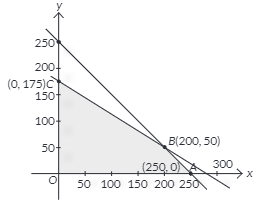
The corner points of the bounded feasible region of an LPP are $O(0,0), A(250,0), B(200,50)$ and $C(0,175)$. If the maximum value of the objective function $Z=2 a x+$ by occurs at the points $A(250,0)$ and $B(200,50)$, then the relation between $a$ and $b$ is:
Image
If $\text{x}=\text{at}^2,\text{y}=2\text{at}$ then $\frac{\text{d}^2\text{y}}{\text{dx}^2}$=
  1. $-\frac{1}{\text{t}^2}$
  2. $\frac{1}{2\text{at}^3}$
  3. $-\frac{1}{\text{t}^3}$
  4. $-\frac{1}{2\text{at}^3}$
Area between the curve $\text{y}=\cos^2\text{x},$  x-axis and ordinates x = 0 and x = p in the interval (0, p) is:
  1. $2\pi3$
  2. $2\pi$
  3. $\pi$
  4. $\frac{\pi}{2}$
If $\int\frac{\text{x}^3\text{dx}}{\sqrt{1+\text{x}^2}}=\text{a}(1+\text{x}^2)^{\frac{3}{2}}+\text{b}\sqrt{1+\text{x}^2}+\text{c,}$ then:
  1. $\text{a}=\frac{1}{3},\text{b}=1$
  2. $\text{a}=\frac{-1}{3},\text{b}=1$
  3. $\text{a}=\frac{-1}{3},\text{b}=-1$
  4. $\text{a}=\frac{1}{3},\text{b}=-1$
The number of solutions of the system of inequations $x+2 y \leq 3,3 x+4 y \geq 12, x \geq 0, y \geq 1$ is