MCQ
The function $f(x)=2 x+3(x)^{\frac{2}{3}}, x \in \mathbb{R}$, has
  • A
     exactly one point of local minima and no point of local maxima
  • B
    exactly one point of local maxima and no point of local minima
  •  exactly one point of local maxima and exactly one point of local minima
  • D
     exactly two points of local maxima and exactly one point of local minima

Answer

Correct option: C.
 exactly one point of local maxima and exactly one point of local minima
c
$ f(x)=2 x+3(x)^{\frac{2}{3}} $

$ f^{\prime}(x)=2+2 x^{\frac{-1}{3}} $

$ =2\left(1+\frac{1}{x^{\frac{1}{3}}}\right) $

$ =2\left(\frac{x^{\frac{1}{3}}+1}{x^{\frac{1}{3}}}\right) $

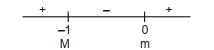
$ +\frac{1}{+}-\mathrm{m}^{-1}$

So, $\operatorname{maxima}(\mathrm{M})$ at $\mathrm{x}=-1$ $\operatorname{minima}(\mathrm{m})$ at $\mathrm{x}=0$

Need a full question paper?

Generate a complete, print-ready paper with questions like this in minutes — across 16+ boards, with answer keys.

Start Generating Free

Similar questions

Let the circumcentre of a triangle with vertices $A ( a , 3), B ( b , 5)$ and $C ( a , b ), ab >0$ be $P (1,1)$. If the line $AP$ intersects the line $BC$ at the point $Q \left( k _{1}, k _{2}\right)$, then $k _{1}+ k _{2}$ is equal to.
If a line makes angles of ${30^o}$ and ${45^o}$ with $x$ - axis and $y$ - axis, then the angle made by it with $z$ - axis is
If $\beta=\lim _{x \rightarrow 0} \frac{e^{x^3}-\left(1-x^3\right)^{\frac{1}{3}}+\left(\left(1-x^2\right)^{\frac{1}{2}}-1\right) \sin x}{x \sin ^2 x}$

then the value of $6 \beta$ is $\qquad$

Let $f(x)=\frac{1}{7-\sin 5 x}$ be a function defined on $R$. Then the range of the function $f(x)$ is equal to:
Let $a_1=i+\frac{1}{i}$ for $i=1,2, \ldots, 20$. Put $p=\frac{1}{20}\left(a_1+a_2+\ldots+a_{20}\right)$ and $q=\frac{1}{20}\left(\frac{1}{a_1}+\frac{1}{a_2}+\ldots+\frac{1}{a_{20}}\right)$ Then,
If ${z_1},{z_2}$ are two complex numbers such that $\left| {\frac{{{z_1} - {z_2}}}{{{z_1} + {z_2}}}} \right| = 1$ and $i{z_1} = k{z_2}$, where $k \in R$, then the angle between ${z_1} - {z_2}$ and ${z_1} + {z_2}$ is
$\int_{}^{} {\frac{{{e^{2x}} + 1}}{{{e^{2x}} - 1}}\;dx} $ equals
In the expansion of ${\left( {\frac{a}{x} + bx} \right)^{12}}$,the coefficient of $x^{-10}$ will be
If $A = \left[ {\begin{array}{*{20}{c}}0&1&{ - 2}\\{ - 1}&0&5\\2&{ - 5}&0\end{array}} \right]$, then
$\left( \vec{a}\times \vec{b} \right)\times \left[ \left( \vec{b}\times \vec{c} \right)\times \left( \vec{a}\times \vec{b}+\vec{b}\times \vec{c}+\vec{c}\times \vec{a} \right) \right]$ is