MCQ
The function $f(x)=|x|$ is
  • A
    continuous and differentiable everywhere.
  • B
    continuous and differentiable nowhere.
  • continuous everywhere, but differentiable everywhere except at $x=0$.
  • D
    continuous everywhere, but differentiable nowhere.
Answer

Correct option: C.
continuous everywhere, but differentiable everywhere except at $x=0$.
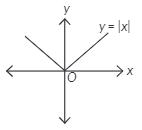
$f(x)=|x|$ = $\left\{\begin{aligned} x, & x>0 \\ -x, & x<0\end{aligned}\right.$
Image
The function $f(x)$ is continuous everywhere but not differentiable at $x=0$ as at $x=0$
$L f^{\prime}(0)=\lim _{x \rightarrow 0^{-}} \frac{f(x)-f(0)}{x-0}$
$=\lim _{x \rightarrow 0} \frac{-x-0}{x}=-1$
$R f^{\prime}(0)=\lim _{x \rightarrow 0^{+}} \frac{f(x)-f(0)}{x-0}$
$=\lim _{x \rightarrow 0} \frac{x-0}{x}=1$
$\therefore L f^{\prime}(0) \neq R f^{\prime}(0),$
so $f(x)$ is not differentiable at $x=0$.

Need a full question paper?

Generate a complete, print-ready paper with questions like this in minutes — across 16+ boards, with answer keys.

Start Generating Free

Similar questions

The length of perpendicular from the origin to the plane which makes intercepts $\frac{1}{3},\frac{1}{4},\frac{1}{5}$​ respectively on the coordinate axes is:
$\max _{0 \leq x \leq \pi}\left\{x-2 \sin x \cos x+\frac{1}{3} \sin 3 x\right\}=$
Let $f(x)$ satisfy all the conditions of mean value theorem in  $[0, 2]. $ If $ f (0) = 0 $ and $|f'(x)|\, \le {1 \over 2}$ for all  $x$ in  $[0, 2]$ then
If $\text{f(x)}=\begin{cases}\frac{1-\sin^2\text{x}}{3\cos^2\text{x}},&\text{if}\text{ x}<\frac{\pi}{2}\\\text{a},&\text{if}\text{ x}=\frac{\pi}{2}\\\frac{\text{b}(1-\sin\text{x})}{(\pi-2\text{x})^2},&\text{if}\text{ x }>\frac{\pi}{2}\end{cases}$ Then $f(x)$ is continuous at $\text{x}=\frac{\pi}{2},$ if :
The functions $u = e^x sin x$ ; $v = e^x cos x$ satisfy the equation :
Solution of the differential equation $\frac{e^x-e^{-x}}{e^x+e^{-x}}=\frac{d x-d y}{d x+d y}$, is
Let $f(x) = \left\{ \begin{array}{l}{(1 + |\sin x|)^{a/|\sin x|}},\,\, - \pi /6 < x < 0\\\,\,\,\,\,\,\,\,\,\,\,\,\,\,\,\,\,\,\,\,\,\,\,\,\,\,\,\,\,\,b,\,x = 0\\{e^{\tan 2x/\tan 3x}},\,0 < x < - \pi /6\end{array} \right.$ then the value of $a$ and $b$ if $f$ is continuous at $x = 0$, are respectively
If A and B are two events such that $\text{P(A)}=\frac{1}{2},\text{P(B)}=\frac{1}{3},\text{P}(\text{A}|\text{B})=\frac{1}{4},$ then $\text{P}(\overline{\text{A}}\cap\overline{\text{B}})$ equals.
Define a function $f: R \rightarrow R$ by $f(x)=\left\{\begin{array}{cc}\frac{\sin x^2}{x}, & \text { for } x<0 \\ x^2+a x+b, & \text { for } x \geq 0\end{array}\right.$ Suppose $f(x)$ is differentiable of $R$. Then,
The solutions of the equation $\left|\begin{array}{ccc}1+\sin ^{2} x & \sin ^{2} x & \sin ^{2} x \\ \cos ^{2} x & 1+\cos ^{2} x & \cos ^{2} x \\ 4 \sin 2 x & 4 \sin 2 x & 1+4 \sin 2 x\end{array}\right|=0,(0< x< \pi), \operatorname{are}$