Question
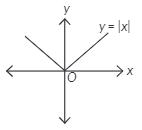
The function $f(x)=|x|$ is

Answer

$f(x)=|x|$ = $\left\{ x, x\} > 0 -x, x<0\right.$
Image
The function $f(x)$ is continuous everywhere but not differentiable at $x=0$ as at $x=0$
$L f^{\prime}(0)=\lim _{x \rightarrow 0^{-}} \frac{f(x)-f(0)}{x-0}$
$=\lim _{x \rightarrow 0} \frac{-x-0}{x}=-1$
$R f^{\prime}(0)=\lim _{x \rightarrow 0^{+}} \frac{f(x)-f(0)}{x-0}$
​​​​​​​$=\lim _{x \rightarrow 0} \frac{x-0}{x}=1$
$\therefore L f^{\prime}(0) \neq R f^{\prime}(0)$, so $f(x)$ is not differentiable at $x=0$.

Need a full question paper?

Generate a complete, print-ready paper with questions like this in minutes — across 16+ boards, with answer keys.
Start Generating Free

Similar questions

The position vectors of P and Q are respectively a and b.If R is a point on PQ, PQ such that PR = 5PQ, then the position vector of R is:
  1. 5b − 4a
  2. 5b + 4a
  3. 4b − 5a
  4. 4b + 5a
$\int\limits^\pi_0\sqrt{\frac{1-\text{x}}{1+\text{x}}}\text{ dx}=$
  1. $\sqrt{1-\pi^2}-1$
  2. $\frac{\pi}{2}-1$
  3. $\frac{\pi}{2}+1$
  4. ${\pi}+{1}$
Let $\text{f(x)}=|\cos\text{x}|.$ Then,
  1. f(x) is everywhere differentiable.
  2. f(x) is everywhere continuous but not differentiable at $\text{x}=\text{n}\pi,\text{n}\in\text{Z}$
  3. f(x) is everywhere continuous but not differentiable at $\text{x}=(2\text{n}+1)\frac{\pi}{2},\text{n}\in\text{Z}.$
  4. None of these.
If for two events $A$ and $B, P(A-B)=\frac{1}{5}$ and $P(A)=\frac{3}{5}$, then $P\left(\frac{B}{A}\right)$ is equal to
Shown below is the curve defined by the equation $y=\log (x+1)$ for $x \geq 0$.
Image
Which of these is the area of the shaded region?
the order of the single matrix obtained from
$\left[\begin{array}{cc}1 & -1 \\ 0 & 2 \\ 2 & 3\end{array}\right]_{3 \times 2}\left\{\left[\begin{array}{ccc}-1 & 0 & 2 \\ 2 & 0 & 1\end{array}\right]_{2 \times 3}-\left[\begin{array}{lll}0 & 1 & 23 \\ 1 & 0 & 21\end{array}\right]_{2 \times 3}\right\}$ is
The number of real solution of the equation
$\sqrt{1+\cos2\text{x}}=\sqrt2\sin^{-1}(\sin\text{x}),-\pi\leq\text{x}\leq\pi$ is:
  1. 0
  2. 1
  3. 2
  4. infinite
$\text{x}\frac{\text{b}-\text{c}}{\text{b}\text{c}}\ \text{x}\frac{\text{c}-\text{a}}{\text{c}\text{a}}\text{x}\frac{\text{a}-\text{b}}{\text{a}\text{c}}=$
The value of $ \cos { \left( \tan ^{ -1 }{ \tan { 4 } } \right) }$ is-
  1. $ \frac { 1 }{ \sqrt { 17 } }$
  2. $ \frac { 1 }{ \sqrt {- 17 } }$
  3. $ \frac { 1 }{ \sqrt {- 14 } }$
  4. $ -\cos 4$
The area bounded by curve x + y = 2, x-axis, and y axis is