MCQ
The function $\text{f}(\text{x})=\sum_{\text{r}=1}^5(\text{x}-\text{r})^{2}$ assume minimum value at $x =$
  • A
    $5$
  • B
    $\frac{5}{2}$
  • $3$
  • D
    $2$

Answer

Correct option: C.
$3$
Given, $\text{f}(\text{x})=\sum_{\text{r}=1}^5(\text{x}-\text{r})^{2}$lmplies that $f(x) = (x - 1)^2 + (x - 2)^2+ (x - 3)^2 + (x - 4)^2 + x - 5^2$
lmplies that $f'(x) = 2(x - 1 + x - 2 + x - 3 + x - 4 + x - 5)$
lmplies that $f'(x) = 2(5x - 15)$
For a local maxima and a local minima, we must have $f'(x) = 0$
limplies that $2(5x - 15) = 0$
limplies that $5x - 15 = 0$
limplies that $x = 3$
Now $, f''(x) = 10$
$f''(x) = 10 > 0$
Therefore, $ x = 3$ is a local minima.

Need a full question paper?

Generate a complete, print-ready paper with questions like this in minutes — across 16+ boards, with answer keys.
Start Generating Free

Similar questions

Forces $3\overrightarrow{\text{OA}},\ 5\overrightarrow{\text{OB}}$ act along OA and OB. If their resultant passes through C on AB, then,
  1. C is a mid-point of AB.
  2. C divides AB in the ratio 2 : 1
  3. 3AC = 5CB
  4. 2AC = 3CB
The number of arbitrary constants in the particular solution of a differential equation of third order is:
  1. 3
  2. 2
  3. 1
  4. 0
The equation of normal to the curve $3x^2 - y^2 = 8$ which is parallel to the line $x + 3y = 8$ is$:$
Let T be the set of all triangles in the Euclidean plane, and let a relation R on T be defined as aRb if a is congruent to b for all a, b ∈ T. Then, R is:
  1. Reflexive but not symmetric.
  2. Transitive but not symmetric.
  3. Equivalence.
  4. None of these.
Let $\text{f(x)}=\begin{vmatrix}\cos\text{x}&\text{x}&1\\2\sin\text{x}&\text{x}&2\text{x}\\\sin\text{x}&\text{x}&\text{x}\end{vmatrix},$ then $\lim_\limits{\text{x}\rightarrow0}\frac{\text{f(x)}}{\text{x}^2}$ is equal to:
The function f : R → R defined by f(x) = (x - 1)(x - 2)(x - 3) is:
  1. One-one but not onto.
  2. Onto but not one-one.
  3. Both one and onto.
  4. Neither one-one nor onto.
If set A contains 5 elements and the set B contains 6 elements, then the number of one-one and onto mappings from A to B is:
  1. 0
  2. 120
  3. 720
  4. None of these.
Find the shortest distance between the given two lines :
$\frac{x+1}{1}=\frac{y+1}{-1}=\frac{z+1}{1}$ and $\frac{x-2}{2}=\frac{y-3}{3}=\frac{z-4}{4}$.
$\text{Area}\text{ of}\text{ ellips}\frac{\text{x}^2}{\text{a}^2}+\frac{\text{y}^2}{\text{b}^2}=1\text{ is:}$
  1. $4\pi\text{ ab}\text{ sq.}\text{ units}$
  2. $2\pi\text{ ab}\text{ sq.}\text{ units}$
  3. $\pi\text{ ab}\text{ sq.}\text{ units}$
  4. $\frac{\pi\text{ab}}{2}\text{ sq.}\text{ units}$
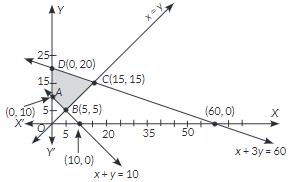
Based on the given shaded region as the feasible region in the graph, at which point(s) is the objective function $Z=3 x+9 y$ maximum?
Image