MCQ
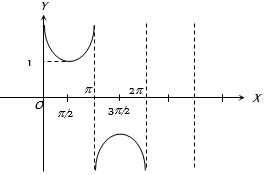
The function which is neither decreasing nor increasing in $\left( {{\pi \over 2},{{3\pi } \over 2}} \right)$ is
  • $cosec\, x$
  • B
    $\tan x$
  • C
    ${x^2}$
  • D
    $|x - 1|$

Answer

Correct option: A.
$cosec\, x$
a
(a) The graph of cosec $ x$  is opposite in $\left( {\frac{\pi }{2},\,\,\frac{{3\pi }}{2}} \right)$.

Need a full question paper?

Generate a complete, print-ready paper with questions like this in minutes — across 16+ boards, with answer keys.

Start Generating Free

Similar questions

Range of the function , $f (x) = cot ^{-1}$ $\left( {{{\log }_{4/5}}\,\,(5\,{x^2}\,\, - \,\,8\,x\,\, + \,\,4)\,} \right)$ is :
The maximum value of $3\cos \theta - 4\sin \theta $ is
If $A = \left[ {\begin{array}{*{20}{c}}4&2\\3&4\end{array}} \right]$,then $|adj\,\,A|$is equal to
${d \over {dx}}\left[ {{{\tan }^{ - 1}}{{\sqrt {1 + {x^2}} + \sqrt {1 - {x^2}} } \over {\sqrt {1 + {x^2}} - \sqrt {1 - {x^2}} }}} \right] = $
If $\sin \theta = \frac{{12}}{{13}},(0 < \theta < \frac{\pi }{2})$ and $\cos \phi = - \frac{3}{5},\left( {\pi < \phi < \frac{{3\pi }}{2}} \right)$. Then $\sin (\theta + \phi )$will be
Let $f(\mathrm{x})=\left\{\begin{array}{cl}-\mathrm{a} & \text { if }-\mathrm{a} \leq \mathrm{x} \leq 0 \\ \mathrm{x}+\mathrm{a} & \text { if } 0<\mathrm{x} \leq \mathrm{a}\end{array}\right.$ where $\mathrm{a}>0$ and $\mathrm{g}(\mathrm{x})=(f|\mathrm{x}|)-|f(\mathrm{x})|) / 2$.  Then the function $\mathrm{g}:[-\mathrm{a}, \mathrm{a}] \rightarrow[-\mathrm{a}, \mathrm{a}]$ is
A straight line moves so that the sum of the reciprocals of its intercepts on two perpendicular lines is constant, then the line passes through
Compute the median from the following table 

Marks obtained

No. of students

$0-10$

$2$

$10-20$

$18$

$20-30$

$30$

$30-40$

$45$

$40-50$

$35$

$50-60$

$20$

$60-70$

$6$

$70-80$

$3$

The sum of three numbers is $6 .$ If we multiply third number by $3$ and add second number to it, we get $11$. By adding first and third numbers, we get double of the second number. Represent it algebraically and find the numbers using matrix method.
Let $A =\{2,3,4,5, \ldots ., 30\}$ and $^{\prime} \simeq ^{\prime}$ be an equivalence relation on $A \times A ,$ defined by $(a, b) \simeq (c, d),$ if and only if $a d=b c .$ Then the number of ordered pairs which satisfy this equivalence relation with ordered pair $(4,3)$ is equal to :