Question
The function$\text{f(x)}=1+|\cos\text{x}|$ is:
  1. Continuous no where.
  2. Continuous everywhere.
  3. Not differentiable at x = 0
  4. Not differentiable at $\text{x}=\text{n}\pi,\text{n}\in\text{Z}.$
Answer

  1. Continuous everywhere.

Solution:

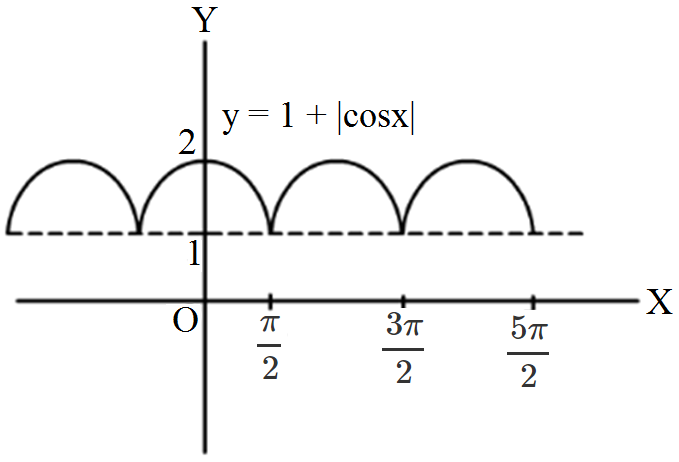
Graph of the function $\text{f(x)}=1+|\cos\text{x}|$ is as show blow:

From the graph, we can see that f(x) is everywhere continuous but not differentiable at $\text{x}=(2\text{n}+1)\frac{\pi}{2},\text{n}\in\text{Z}.$

Need a full question paper?

Generate a complete, print-ready paper with questions like this in minutes — across 16+ boards, with answer keys.

Start Generating Free

Similar questions

If $f(x)=\left|\begin{array}{ccc}x^3 & 2 x^2+1 & 1+3 x \\ 3 x^2+2 & 2 x & x^3+6 \\ x^3-x & 4 & x^2-2\end{array}\right|$ for all $x \in \mathbb{R}$, then $2 f(0)+f^{\prime}(0)$ is equal to
If $p, q, r$ are $3$ real numbers satisfying the matrix equation, $[p\,q\,r]\,\left[ {\begin{array}{*{20}{c}}
3&4&1\\
3&2&3\\
2&0&2
\end{array}} \right] = [3\,\,\,0\,\,\,1]$ then $2p + q - r$ equals
$\int_{}^{} {{x^2}{{(3)}^{{x^3} + 1}}dx = } $
If the direction ratios of two lines are given by 3lm - 4ln + mn = 0 and l + 2m + 3n = 0, then the angle between the lines is:

  1. $\frac{\pi}{6}$

  2. $\frac{\pi}{4}$

  3. $\frac{\pi}{3}$

  4. $\frac{\pi}{2}$

The value of $\int_0^\pi {{e^{{{\cos }^2}x}}{{\cos }^5}3x} \,dx$ is
The area bounded by y = 2 - x2 and x + y = 0 is:
  1. $\frac{7}{2}\text{ sq. units}$
  2. $\frac{9}{2}\text{ sq. units}$
  3. $9\text{ sq. units}$
  4. $\text{none of these}$
If $A = \left[ {\begin{array}{*{20}{c}}3&5\\2&0\end{array}} \right]$ and $B = \left[ {\begin{array}{*{20}{c}}1&{17}\\0&{ - 10}\end{array}} \right]$ then $|AB|$ is equal to
If $\begin{vmatrix}\text{a}&\text{p}&\text{x}\\\text{b}&\text{q}&\text{y}\\\text{c}&\text{r}&\text{z}\end{vmatrix}=16,$ then the value of $\begin{vmatrix}\text{p}+\text{x}&\text{a}+\text{x}&\text{a}+\text{p}\\\text{q}+\text{y}&\text{b}+\text{y}&\text{b}+\text{q}\\\text{r}+\text{z}&\text{c}+\text{z}&\text{c}+\text{r}\end{vmatrix}$ is:
  1. 4
  2. 8
  3. 16
  4. 32
The function $f(x) = {{{\rm{ln}}(\pi + x)} \over {{\rm{ln}}(e + x)}}$ is
Choose the correct answer in Exercises:
$\int\frac{\sin^2\text{x}-\cos^2\text{x}}{\sin^2\text{x}\cos^2\text{x}}\text{ dx}$ is equal to
  1. $\tan\text{x}+\cot\text{x}+\text{C}$
  2. $\tan\text{x}+\text{cosec x}+\text{C}$
  3. $-\tan\text{x}+\cot\text{x}+\text{C}$
  4. $\tan\text{x}+\sec\text{x}+\text{C}$