Question
The function$\text{f(x)}=1+|\cos\text{x}|$ is:
  1. Continuous no where.
  2. Continuous everywhere.
  3. Not differentiable at x = 0
  4. Not differentiable at $\text{x}=\text{n}\pi,\text{n}\in\text{Z}.$
Answer

  1. Continuous everywhere.

Solution:

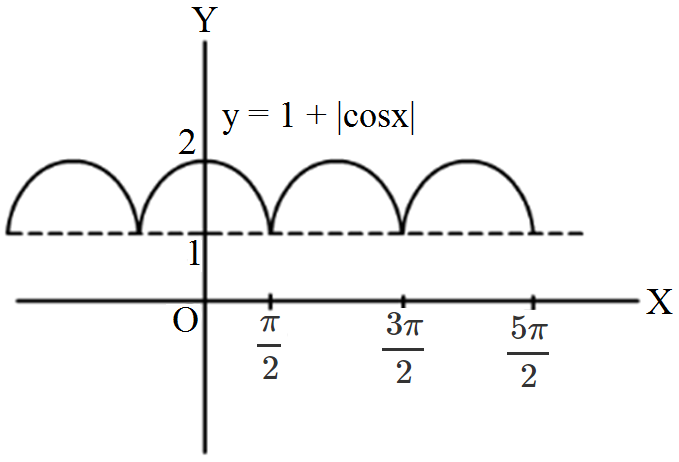
Graph of the function $\text{f(x)}=1+|\cos\text{x}|$ is as show blow:

From the graph, we can see that f(x) is everywhere continuous but not differentiable at $\text{x}=(2\text{n}+1)\frac{\pi}{2},\text{n}\in\text{Z}.$

Need a full question paper?

Generate a complete, print-ready paper with questions like this in minutes — across 16+ boards, with answer keys.

Start Generating Free

Similar questions

A letter is known to have come either from LONDON or CLIFTON; on the postmark only the two consecutive letters ON are ellegible. The probability that it came from LONDON is:
A special lottery is to be held to select a student who will live in the only deluxe room in a hostel. There are 100 Year-III, 150 Year-II and 200 Year-I students who applied. Each Year-III's name is placed in the lottery 3 times; each Year-II's name, 2 times and Year-I's name, 1 time. What is the probability that a Year-III's name will be chosen?
$\int_{\, - \,1}^{\,0} {\frac{{dx}}{{{x^2} + 2x + 2}} = } $
Area common to the curve $y =\sqrt {9\, - \,{x^2}} $  $\& \,\,x^2 + y^2 = 6$ $x$ is :
$\int {\left( {\sin x\cos x\cos 2x\cos 4x\cos 8x} \right)dx}$ equal
The interval for which ${\sin ^{ - 1}}\sqrt x + {\cos ^{ - 1}}\sqrt x = \frac{\pi }{2}$ holds
The value of c in Rolle's theorem for the function $\text{f}(\text{x})=\frac{\text{x}(\text{x}+1)}{\text{e}^{\text{x}}}$ defined on [-1, 0] is:
  1. $0.5$
  2. $\frac{1+\sqrt5}{2}$
  3. $\frac{1-\sqrt5}{2}$
  4. $-0.5$
For $x > 1,\;\int_{}^{} {\frac{1}{{x({x^4} - 1)}}\;dx = } $
For each real number $x$ such that $ - 1 < x < 1,$let $A(x)$ be the matrix ${(1 - x)^{ - 1}}\left[ {\begin{array}{*{20}{c}}1&{ - x}\\{ - x}&1\end{array}} \right]$ and $z = \frac{{x + y}}{{1 + xy}}$ Then
For $x > 0$, let $h(x) = \begin{array}{*{20}{c}}
{\frac{1}{q}\,\,\,\,\,\,\,\,\,\,\,\,\,\,\,\,\,\,\,\,\,\,\,\,\,\,if{\mkern 1mu} {\mkern 1mu} {\mkern 1mu} x{\mkern 1mu} {\mkern 1mu}  = {\mkern 1mu} {\mkern 1mu} \frac{p}{q}}\\
{0\,\,\,\,\,\,\,\,if{\mkern 1mu} {\mkern 1mu} x\,{\mkern 1mu} is{\mkern 1mu} irrational\,\,\,}
\end{array}$ are relativily prime integer then which one does not hold good ?