MCQ
The function$\text{f(x)}=1+|\cos\text{x}|$ is:
  • A
    Continuous no where.
  • Continuous everywhere.
  • C
    Not differentiable at x = 0
  • D
    Not differentiable at $\text{x}=\text{n}\pi,\text{n}\in\text{Z}.$
Answer

Correct option: B.
Continuous everywhere.
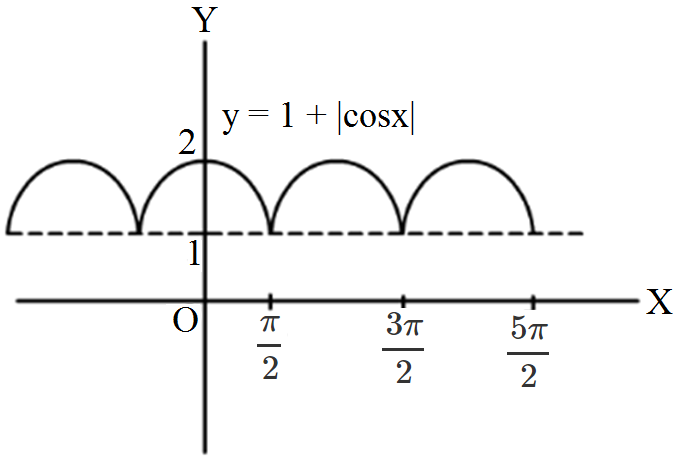
Graph of the function $\text{f(x)}=1+|\cos\text{x}|$ is as show blow:


From the graph, we can see that f(x) is everywhere continuous but not differentiable at $\text{x}=(2\text{n}+1)\frac{\pi}{2},\text{n}\in\text{Z}.$

Need a full question paper?

Generate a complete, print-ready paper with questions like this in minutes — across 16+ boards, with answer keys.

Start Generating Free

Similar questions

If the points whose position, vectors are $3i - 2j - k,$ $2i + 3j - 4k,$ $ - i + j + 2k$and $4i + 5j + \lambda k$ lie on a plane, then $\lambda = $
The area (in sq. units) of the region

$\left\{(\mathrm{x}, \mathrm{y}) \in \mathrm{R}^{2} | 4 \mathrm{x}^{2} \leq \mathrm{y} \leq 8 \mathrm{x}+12\right)$ is 

Let $\mathrm{M}$ and $\mathrm{m}$ respectively be the maximum and minimum values of the function $f(x)=\tan ^{-1}(\sin x+\cos x)$ in $\left[0, \frac{\pi}{2}\right]$, Then the value of $\tan (\mathrm{M}-\mathrm{m})$ is equal to:
The value of $\left| {\,\begin{array}{*{20}{c}}{{1^2}}&{{2^2}}&{{3^2}}\\{{2^2}}&{{3^2}}&{{4^2}}\\{{3^2}}&{{4^2}}&{{5^2}}\end{array}\,} \right|$ is
$\int_{}^{} {\frac{{{x^5}\;dx}}{{\sqrt {(1 + {x^3})} }} = } $
If $X$ is a random variable with probability distribution as given below :
$X = x_i$ $0$ $1$ $2$ $3$
$P(X = X_i)$ $k$ $3k$ $3k$ $k$
The value of $k$ and its variance are :
$\left|\begin{array}{cc}\cos \theta & -\sin \theta \\ \sin \theta & \cos \theta\end{array}\right|=$
The function $\text{f}:\Big[\frac{-1}{2},\frac{1}{2},\frac{1}{2}\Big]\rightarrow\ \Big[\frac{-\pi}{2},\frac{\pi}{2}\Big],$ defined by $\text{f(x)}=\sin^{-1}(3\text{x}-4\text{x}^3),$ is:
If $f\left( x \right) = \left\{ {\begin{array}{*{20}{c}}
  {\sqrt {1 - x} \,;\,\,\,\,\,\,\,\,\,}&{0 \leqslant x \leqslant 1} \\ 
  {{{\left( {7x - 6} \right)}^{ - 1/3}};}&{1 < x \leqslant 2} 
\end{array}} \right.$ , then $\int\limits_0^2 {f\left( x \right)} dx$ is equal to
A relation $R$ is defined from $\{2, 3, 4, 5\}$ to $\{3, 6, 7, 10\}$ by $: xRy \Leftrightarrow x$ is relatively prime to $y.$ Then, domain of $R$ is: